Fractured Europe


europeEurope in Autumn; Europe at Midnight; Europe in Winter

by Dave Hutchinson

A review by David Grigg from The Fretful Porpentine 

The first book in this ‘Fractured Europe’ series was recently recommended to me by Carey Handfield, and I bought it as a ebook for a few dollars. Then I rapidly went out and bought the second. The third, maddeningly, wasn’t yet out, but I placed it on pre-order and it arrived a couple of weeks ago.

So I read these three books in a matter of a few weeks. And then I turned around and immediately read them all through again from cover to cover, and I’m glad I did—so much I had missed or not understood now became clear(er). But even now I’m not sure that I fully understand what has been going on, and I’m wondering if there will be a fourth or fifth book in the series which may reveal more. Talk about ‘a riddle, wrapped in a mystery, inside an enigma‘? (A not inappropriate quotation, as it turns out).

Where to start? Well, first we have to set the scene, which is the near-term future in Europe after the European Union has essentially broken up back into its individual nations. But the rot hasn’t stopped there, and there’s a wave of independent nations, principalities or ‘polities’ breaking off from those nations, as regional and ethnic loyalties come to the fore. This reaches an almost absurd degree, with in some cases a few blocks of some cities declaring their independence. The whole concept of the Schengen Treaty of doing away with borders in Europe is now a sad, half-forgotten joke. Borders and border controls are everywhere.

Even more interesting, a trans-continental railway line has been built from Spain through to Eastern Sibera. On its completion the company promptly declares the railway and the land immediately surrounding it to be sovereign territory, and that the Line is now an independent nation. The Lines stations are Consulates. One needs a visa to travel on the train, and to become a citizen to work for the Line. The author somehow makes this all seem perfectly rational.

We’re introduced to Rudi, the young Estonian-born chef at Restaurant Max in Krakow, in Poland. Through some shady connections of his boss Max, Rudi is eventually recruited into a shadowy organisation called Les Coureurs de Bois (“the runners of the woods”?). It’s kind of a courier operation, carrying mail and packages from one nation to another—something no longer easy, or even necessarily legal. It’s like a cross between a courier company, a smuggling ring, and an espionage outfit. Most governments heavily disapprove of it.

For most of the first book, were learning about Rudi and following him on the various Situations he’s placed in from time to time (while still mostly working as a chef). Some of these go well, a few go wrong, and eventually disastrously wrong. Something very strange is going on, and Rudi finds that he is being hunted and that his life is in danger. All of this (other than the slightly futuristic setting) has the engaging fascination of a spy thriller, or perhaps one of the Jason Bourne movies. Apart from the occasional use of advanced technology like ‘stealth suits’, this all seems barely like science fiction at all.

I can’t describe too much more without spoilers. Suffice it to say that about 80% through the first book, Rudi has finally tracked down what a dying former Coureur tells him is ‘the proof’. It’s in the deciphering of this proof that Rudi discovers a secret which does plunge us into real science fiction territory.

I enjoyed the second book even more than the first, as we encounter the first person narrative of ‘Rupert’ who lives in a vast (really vast) university campus run as a totalitarian regime, which has just undergone a bloody revolution. How this ties in with what Rudi has discovered in the first book takes quite a while to emerge.

It was really worthwhile re-reading the books. So much of what is going on in earlier parts of the narrative is explained by what comes later that you are almost compelled to go back and read those earlier passages again. It’s a tribute to how good the writing is that all three books were just as enjoyable to read again so soon.

Puzzling, challenging, but very good. Written, by someone who seems to know Eastern Europe (and the restaurant trade) very well; very clever plotting; really original concepts; great characterisation. I loved them and look forward to reading more from this author.
End of an Era: 30 years of Critical Mass

You’re cordially invited to join us in celebrating thirty years of this discussion group which meets once a  month to critically discuss SF & Fantasy.
Traditionally, our last meeting of the year is an outing for food & drink.

This Wednesday, December 7th, we’re meeting at a cafe/bar called East of Norman, which is on Sturt Street, just east of Norman Street, adjacent to the Ergo Apartments.
Turn up at 6pm, and feel free to bring a friend to help celebrate!

https://www.facebook.com/events/211529335965878/

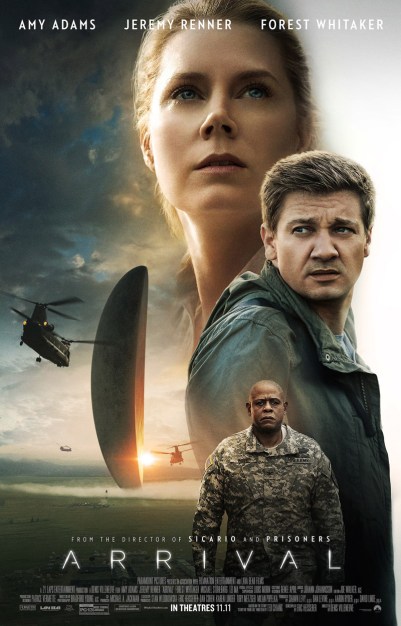
Arrival

arrivalposter

The new SF film by Denis Villeneuve is an adaptation of Ted Chiang’s Award winning novella,  Story of Your Life (winner of the Nebula and Sturgeon, shortlisted for the Tiptree).

It’s a First Contact situation, with  Amy Adams and Jeremy Renner playing  a linguist and a physicist whose specialties are called upon when aliens land all over Earth and we try to find a way to communicate with the visitors.

In the novella, the linguist, Louise Banks, describes the complexity of the alien (named Heptapods) written language:
The heptapods didn’t write a sentence one semagram at a time; they built it out of strokes irrespective of individual semagrams. I had seen a similarly high degree of integration before in calligraphic designs, particularly those employing the Arabic alphabet. But those designs had required careful planning by expert calligraphers. No one could lay out such an intricate design at the speed needed for holding a conversation. At least, no human could.

Here’s an excerpt from an interview with Ted Chiang by Meghan McCarron (full interview in the Electric lit site):
Film really is an alien language. Or at least it’s a language that I have some fluency in as a listener, but one that I don’t speak at all. I’ve always been aware of this at some level, but I was definitely reminded of it when I was first approached about the adaptation of “Story of Your Life,” because it’s not a story that I would have ever pitched to be made into a film. And this ties in with what we were saying about how deeply the written word is embedded in our consciousnesses. Because when a story idea crystallizes in my mind, what I’m thinking about are sentences. I assume that if I were a screenwriter, I’d be picturing scenes, and it makes me wonder about how deep are the differences between these two modes of storytelling.

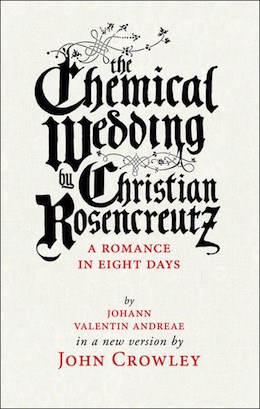
the Chemical Wedding

chemicalwedding-cover

alchemy was once a cutting-edge science, one that well-respected men like Isaac Newton and Giordano Bruno thought would heal society’s political and religious rifts. Crowley’s new edition of the alchemical Wedding attempts to resituate it in these terms. Published during the year of the book’s 400th anniversary, with Gorey-like illustrations by Theo Fadel, The Chemical Wedding is living and breathing yet again, reopening a bizarre and understudied chapter in European history.
— Emily Nordling,  The Alchemy of SciFi: John Crowley’s New Telling of The Chemical Wedding book review at Tor.com

SF films of note

Screen Shot 2016-10-05 at 9.07.35 pm.png
A personal list of SF films worth watching!

  • Metropolis (1927, as restored)

    Fritz Lang & Thea von Harbou’s masterpiece. If you haven’t seen the most recent restoration, which restored broken or missing storylines, you need to see the movie again. This new, restored version is truely stunning to behold, and tells a complex and gripping tale.

  • The Man in the White Suit (1951)

    This old Ealing comedy features Alec Guinness as an eccentric inventor of a spotless fabric. Very, very funny.

  • The Day the Earth Stood Still (1951)
    Michael Rennie was ill, …
  • War of the Worlds (Geo. Pal, 1953)
    The strange cross between flyng saucers and martian tripods works, and the story still works even transplanted to the US.
  • Invasion of the Body Snatchers (1956)
    Who can forget the shot of the man, running down the road, trying to warn people?
  • Forbidden Planet (1956)
    Robby the Robot! Shakespeare! Flying saucers!
  • The Time Machine (1960)

    I admit it, I just loved the gorgeous design of this Time Machine.

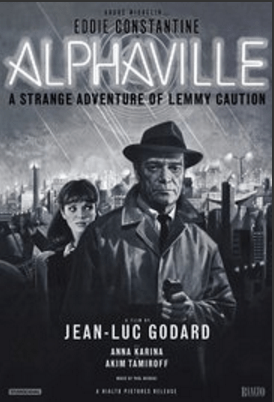
  • Alphaville (1965) une étrange aventure de Lemmy Caution
    Jean-Luc Godard film about a totalitarian city of the future. Very unsettling
  • 2001: A Space Odyssey (1968)

    Kubrick captures the grandeur of space. Lots of fun watching the Star Wars generation puzzling over the apeman opening!

  • Charly (1968)

    A very nice adaptation of the short story Flowers for Algernon

  • A Clockwork Orange (1971)
  • The Andromeda Strain (1971)

    The clock is ticking as a bunch of scientists deal with an infestation from space.

  • Dark Star (1975)

    I first saw this at Aussiecon, then screened it the following year in Adelaide. A funny and clever film about the mental hazards of deep space with a small crew.

  • Stalker (Andrei Tarkovsky, 1979)

    a beautifully filmed version of Roadside Picnic, and a meditation on the sadness in the Russian soul. Possibly a tad too slow for modern audiences, but there’s actually a lot happening.

  • Alien (1979)

    Ridley Scott, and Sigourney Weaver as Ripley!

  • Blade Runner (1982)

    Ridley Scott’s beautiful and intelligent adaptation of PK Dick’s Do Android’s dream of Electric Sheep? set a high standard for SF films.

  • Fifth Element (1997)

    Luc Besson’s glorious space opera romp, beautiful to behold and fun to watch.

  • Dark City  (1998)

    Classic 1950s man into superman story. Filmed around Central Station in Sydney.

  • Minority Report (2002)

    Spielberg film of another PK Dick story. Max von Sydow is excellent!

  • A Scanner Darkly (2006)

    Richard Linklater doing SF! Based on the PK Dick story. Very interesting rotoscoping of the actors.

  • District 9 (2009)

    Intelligent SF commenting on Apartheid and racism.

  • Inception (2010)

    Entering people’s dreams to embed/steal ideas. The question is, how do you know when you’re awake? A nice caper involving layers of “reality”.

  • Attack the Block (2011)

    Unlikely heroes save their block from alien invasion

Welcome to the new Critical Mass

And as imagination bodies forth
The forms of things unknown, the poet’s pen
Turns them to shapes and gives to airy nothing
A local habitation and a name.

– WILLIAM SHAKESPEARE (A MIDSUMMER NIGHT’S DREAM)

This site is designed for members of Critical Mass to share news, reviews, and talks about SF, Fantasy and related works.

Feel free to add a post, or comment on other posts.

If you’re new to wordpress, or blogging, you can have a look at this quick guide, or you might find this more detailed guide by Dona Fontenot useful.


Bradbury Award

I know it was announced months ago at the Nebula Awards ceremony, but I just wanted to point out the well deserved win by George Miller and his team.

Ray Bradbury Award for Outstanding Dramatic Presentation Winner: Mad Max: Fury Road, Written by George Miller, Brendan McCarthy, Nick Lathouris

Other nominees:
Ex Machina, Written by Alex Garland
Inside Out, Screenplay by Pete Docter, Meg LeFauve, Josh Cooley; Original Story by Pete Docter, Ronnie del Carmen
Jessica Jones: AKA Smile, Teleplay by Scott Reynolds & Melissa Rosenberg; Story by Jamie King & Scott Reynolds
The Martian, Screenplay by Drew Goddard
Star Wars: The Force Awakens, Written by Lawrence Kasdan & J.J. Abrams and Michael Arndt

Details of the nominees and winners of the Nebulas at SFWA

Feet of Clay

Feet of Clay is the new production by the Unseen Theatre Company, another australian premiere of a Terry Pratchett Discworld story.

Runs at the Bakehouse, Wed to Sat at 7:30 until Nov 5thscreen-shot-2016-10-27-at-1-35-47-pm

Unlike the previous production, Wee Free Men, this is a more compact story, a who done it with murders and villainous plots— or more precisely, a how done it, as the head of the Ankh-Morpork City Watch, Commander Sam Vimes (played by Mike Shaw), tries to figure out the connection between a puzzling series of murders and the attempted poisoning of the Patrician, ruler of the city. The familiar shape of the murder mystery setting makes for an exciting tale, even if you’re unfamiliar with the exotic setting in Discworld.

Along the way, we encounter the Dragon King of Arms in the heraldry shop (a nice performance as a haughty vampire by Belinda Spangenberg), with a suitable groan worth of puns in the coats of arms presented for our delight.

We also encounter a lost Golem, the Watch’s new dwarf Alchemist (someone’s got to do all the CSI forensic stuff, right?) — Cheery Littlebottom — played by Alycia Rabig in an awesome beard, with a fondness for sparkly earrings…

It turns out a lot is at stake, as Lord Vetinari (Danny Sag) is being slowly — but surely — poisoned, despite the best efforts of Vimes & the City Watch to protect him. If only they could figure out how the poison is being introduced…

Meanwhile, various guilds are plotting to reintroduce the monarchy to introduce stability in succession upon the patrician’s death.

Kahlia Tutty reprises her role as Angua, and Hugh O’Connor turns in a nice performance as Captain Carrot, to round out the capable City Watch team.

The set makes good use of the stage, with an elevated office for the Patrician (naturally) on one side, and a City Watch desk on the other side of the stage. Twin doors centre stage represent a couple of shop locations, and there’s room front stage for street scenes.

It’s a fun evening, running around 2 hours, including an intermission. 

Worth a look!