
The novel is usually regarded as a realist art form, and I’d go even further: By telling the stories we use to understand our lives, the novel helps create our reality. In novels, things go wrong—that’s plot. People then cope. That’s realism.
— “The Novel Solutions of Utopian Fiction,” Kim Stanley Robinson, The Nation, Aug 2nd
Utopia, on the other hand, is famously “no place,” an idealized society sometimes described right down to its sewage system. In utopia, everything works well—maybe even perfectly, but for sure better than things work now. So utopias are like blueprints, while novels are like soap operas. Crossing these two genres gets you the hybrid called the utopian novel: soap operas put in a blender with architectural blueprints. It doesn’t sound all that promising.
Then came Ursula K. Le Guin’s The Dispossessed. Published in 1975, this was the first great utopian novel, and it demonstrated just how good the poor, misbegotten hybrid can be. Of course, there’d been earlier utopian novels, like William Morris’s News From Nowhere, or H.G. Wells’s A Modern Utopia, or Charlotte Perkins Gilman’s Herland, or Aldous Huxley’s Island. These were all interesting efforts. But Le Guin’s book was a triumph. What she showed is that by describing a utopian society in a moment of historic danger, you create for it all kinds of problems that its characters must solve. It will get attacked from the outside, corrupted from the inside; things will go wrong, and so you have your plot. Le Guin combined an intriguing utopia with a compelling novel, and the result was superb. The people on her habitable moon, Annares, have formed an alternative society to the imperial capitalist world, Urras. They devised a system that is feminist for sure and either democratic socialist or anarcho-syndicalist, but in any case in a state of flux, its people doing everything they can to keep what’s best about their system while also fending off impositions from the home world. It’s political fiction at its best.
Monsters and Monster Lovers
As was mentioned at the last Critical Mass, fanac.org have a channel at youtube.com.
One of the interesting items was a slideshow from the 1964 Worldcon, featuring Fritz Leiber
talking about Monsters and Monster Lovers.
Cattitude!
The 2021 Cattitude Bundle, curated by Kristine Kathryn Rusch:
Cats. The internet loves them because we love them. We love cats in all their incarnations—playful, magical, irritating, and yes, occasionally evil. This StoryBundle explores the range of cats and cat behaviors as well. From the familiars to winged space cats, from cats who facilitate romance to cats who rescue others, every type of cat appears in this StoryBundle. Perfect for a day at the beach (without a cat) or at home in the AC (with cats nearby).
There are 10 books (four StoryBundle exclusives!) in the bundle :

More details at StoryBundle — Note: available until 18th August
Clarke Award Shortlist
The shortlist for the 35th Arthur C. Clarke Award has been announced:
- The Infinite , Patience Agbabi (Canongate)
- The Vanished Birds, Simon Jimenez (Titan)
- Vagabonds, Hao Jingfang (Head of Zeus)
- Edge of Heaven, R.B. Kelly (NewCon)
- The Animals in that Country, Laura Jean McKay (Scribe)
- Chilling Effect, Valerie Valdes (Orbit)
The 2021 judges are Phoenix Alexander, Nicole Devarenne, Stewart Hotston, Nick Hubble, and Alasdair Stuart, with Andrew M. Butler serving as the non-voting Chair of the Judges. The shortlist was selected from 105 titles submitted by 41 individual UK publishing imprints and independent authors. The winner will be announced in an award ceremony in September. For more information, see the Clarke Award website. (with thanks to Locus).
Nova Mob, Aug 4th: Fritz Leiber
The August meeting will be by Zoom.
Nova Mob: 4th August 2021: Charles Taylor on Fritz Leiber
Nova Mob by Zoom only
Aug 4, 2021 8:00pm Canberra, Melbourne, Sydney; 7:30pm Adelaide
Zoom access available after 7pm Adelaide and will close at 9.15pm Adelaide to allow for chat
Join Zoom Meeting
https://us02web.zoom.us/j/4177583193?pwd=VjdPL1BhSTBNclN2YnRsejN3Y1hlUT09
Meeting ID: 417 758 3193
Passcode: nova
Murray notes:
💥 💥 💥
FRITZ LEIBER
Well known for his Fafhrd and the Grey Mouser stories, and for inventing the term “sword and sorcery”.

(1910-1992) US author, his work runs the gamut from sf through fantasy and horror, with many tales achieving an eloquent Equipoise that enabled him to jostle various genres together, riding them with a freedom unusual for the period of their composition, making him a powerful model for later writers.
http://www.sf-encyclopedia.com/entry/leiber_fritz
Well known for his Fafhrd and the Grey Mouser stories, and for inventing the term “sword and sorcery”.
His awards and honours speak for themselves:
· Guest of honour at World Science Fiction Convention, 1951, 1979;
· Hugo Award, World Science Fiction Convention, for best novel, 1958, for The Big Time, and 1965, for The Wanderer, for best novelette, 1968, for “Gonna Roll the Bones,” for best novella, 1970, for “Ship of Shadows,” and 1971, for “Ill Met in Lankhmar,” and for best short story, 1975, for “Catch That Zeppelin”;
· Nebula Award, Science Fiction Writers of America, for best novelette, 1968, for “Gonna Roll the Bones,” for best novella, 1971, for “Ill Met in Lankhmar,” for best short story, 1975, for “Catch That Zeppelin,” and Grand Master, 1981, for lifetime contribution to the genre;
· Ann Radcliffe Award, Count Dracula Society, 1970;
· Gandalf Award, World Science Fiction Convention, 1975;
· August Derleth Fantasy Award, 1976, for “Belsen Express”;
· World Fantasy Award, World Fantasy Convention, for best short fiction, 1976, for “Belsen Express,” and for best novel, 1978, for Our Lady of Darkness;
· World Fantasy Life Award, World Fantasy Convention, 1976, for life achievement;
· Locus Award, best collection, 1986, for The Ghost Light;
· Bram Stoker Lifetime Achievement Award, 1988.
Critical Mass, July 28th: a chat with Rob Hansen via Zoom
Due to the likelihood of continuing restrictions on gatherings, the July Critical Mass will be Zoom only.
We will not be meeting at Kappys, so you can enjoy the chat in your own home.

Please join us at 6:30pm Wednesday for a chat with Rob Hansen, who describes himself as “an old time fan since the mid 1970s whose main output these days is almost all related to British fan history”.
Rob Hansen wrote a history of British fans THEN: SF fandom in the UK, 1930-1980. Currently available as an updated version from Ansible Editions.

In 2019, he co-edited a compilation of fan writings with Vince Clarke: THEN Again: A UK Fanhistory Reader 1930-1979.
Available from the TAFF Ebooks site for a donation, this companion to Rob Hansen’s monumental THEN brings together the writings of many players on the stage of British and Irish fandom from 1930 to the end of 1979, telling in their own words the stories of SF groups – including the BSFA – fanzines, famous fannish addresses, bizarre fan activities and much more.

Rob’s latest ebook, FAAN FICTION (1930-2020), is also available at the TAFF ebook site.
In this combined critique and anthology, Rob Hansen discusses the phenomenon of fan fiction (in the fannish fanzine sense) with a particular focus on the UK. His commentary is interspersed with many examples from such diverse fan writers as John Berry, C.S. Youd (John Christopher), Leroy Kettle, David Langford, Mark Plummer, Bob Shaw, Ian Sorensen, James White, Walt Willis – and Rob Hansen himself, including previously unpublished work. There are several surprises.
We’ll talk about the selection and reprinting of fannish writings as Epubs (both the Ansible ebooks and the TAFF collections).
6:25 for a 6:30 start (Adelaide time) via zoom only.
Zoom detail:
Topic: July Critical mass
Time: Jul 28, 2021 6:30pm Adelaide, 7pm Melbourne, 10am London
Rob Hansen on SF Fandom in the UK and the reprint of fannish writing.
Rob will talk for about 20 minutes, then we’ll open it up for questions and discussion.
Join Zoom Meeting
https://us02web.zoom.us/j/87838007079?pwd=TWcvMUJBOFNIOVBIQVJQOEc2ckhWZz09
Meeting ID: 878 3800 7079
Passcode: CritMass
More Sandman from Audible
The next season of Audible’s Sandman audio drama is nearly here. According to the audiobook company, it will be released on September 22nd.
Audible released the adaptation a little over a year ago — a 10-hour audio drama based on Neil Gaiman’s comic series, following the story of the Sandman, aka Lord Morpheus as he’s imprisoned on Earth by a cult. Earlier this year, Audible announced that it had renewed the series for an additional two volumes Dirk Maggs, who directed the first volume, will return to work on the next two, while Gaiman will return as narrator.
We know who’ll star in the project: McAvoy will return as Dream/Lord Morpheus, as well as Kat Dennings (Death), Michael Sheen (Lucifer), and Andy Serkis (Matthew the Raven).
The new season will also include Emma Corrin (Thessaly), Brian Cox (Augustus), Arthur Darvill (William Shakespeare), Miriam Margolyes (Despair), John Lithgow (Emperor Joshua Norton), Joanna Lumley (Lady Johanna Constantine), Bebe Neuwirth (Bast), Bill Nighy (Odin), Regé-Jean Page (Orpheus), Kristen Schaal (Delirium), Kevin Smith (Merv Pumpkinhead), David Tennant (Loki), Niamh Walsh (Nuala), and Jeffrey Wright (Destiny).
Andrew Liptak, “Audible Reveals Cast and Release Date for Sandman Act II Audio Drama”, tor.com
Dune Soundtracks released
Whenever I see that a director has brought on Hans Zimmer to score a film, I inevitably give the soundtrack a listen, regardless of whether or not I enjoy (or even see) the film. When Warner Bros. announced that he’d be scoring Dune, it immediately became one of the components that I’ve been looking forward to the most.
Now, we can get a listen to what’s in store: WaterTower Music has released two tracks from the film that give us a sense of what Denis Villeneuve’s adaptation will sound like.
Andrew Liptak, “Listen to Two Tracks From Hans Zimmer’s Dune Soundtrack”, tor.com
The Lost Star Wars show…
Somewhere, 39 completed, official episodes of a Star Wars television show exist. A show George Lucas helped create. A show with Darth Vader, Han Solo, Obi-Wan Kenobi, and more. And yet, according to the show’s co-creator, odds are we’ll never get to see any of it.
io9, “Star wars detours release not likely”
That show is called Star Wars Detours and it was announced back in 2012. Co-created by the Robot Chicken team of Seth Green and Matthew Senreich, Detours was an officially licensed Star Wars animated comedy using characters from all the films up to that point. Lucas himself even gave his approval and consulted with Green and Senreich on the show. Brief glimpses were released (as well as a description Gizmodo truly trashed at the time), but when Disney purchased Lucasfilm soon after the announcement, the show was shelved awaiting further actions. Now, in a new interview with Entertainment Weekly, Green says that’s kind of where things still are almost a decade later.

The Radium Age
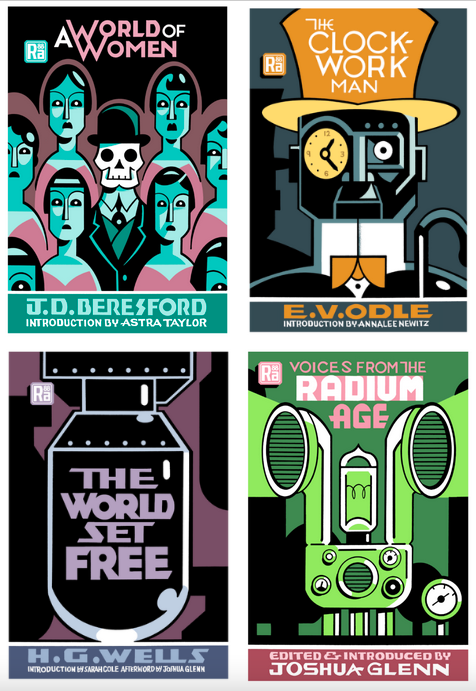
Under the direction of Joshua Glenn, the MIT Press’s Radium Age is reissuing notable proto–science fiction stories from the underappreciated era between 1900 and 1935. With new contributions by historians, science journalists, and science fiction authors, the Radium Age book series will recontextualize the breakthroughs and biases of these proto–science fiction classics, and chart the emergence of a burgeoning genre.
Glenn says Do we really know science fiction? There were the Scientific Romance years that stretched from the mid-19th century to circa 1900. And there was the so-called Golden Age, from circa 1935 through the early 1960s. But between those periods, and overshadowed by them, was an era that has bequeathed us such memes as the robot (berserk or benevolent), the tyrannical superman, the dystopia, the unfathomable extraterrestrial, the sinister telepath, and the eco-catastrophe. A dozen years ago, writing for the sf blog io9.com at the invitation of Annalee Newitz and Charlie Jane Anders, I became fascinated with the period during which the sf genre as we know it emerged. In honor of Marie Curie, who shared a Nobel Prize for her discovery of radium in 1903, only to die of radiation-induced leukemia in 1934, I dubbed it the “Radium Age.”
from http://file770.com/
 The Adelaide Fan Review
You must be logged in to post a comment.