“It’s important to remember that the term “space opera” was first devised as an insult.
“This term, dropped into the lexicon by fan writer Wilson Tucker, initially appeared in the fanzine Le Zombie in 1941. It was meant to invoke the recently coined term “soap opera” (which then applied to radio dramas), a derogatory way of referring to a bombastic adventure tale with spaceships and ray guns. Since then, the definition of space opera has been renewed and expanded, gone through eras of disdain and revival, and the umbrella term covers a large portion of the science fiction available to the public. It’s critical opposite is usually cited as “hard science fiction,” denoting a story in which science and mathematics are carefully considered in the creation of the premise, leading to a tale that might contain more plausible elements.
“This had led some critics to posit that space opera is simply “fantasy in space.” But it isn’t (is it?), and attempting to make the distinction is a pretty fascinating exercise when all is said and done.”
— Emily Asher-Perrin, “Is Space Opera Merely Fantasy Set in Space?” in Tor.com
(worth a look at the article for the backcover of the first issue of Galaxy)
The Moonscapes Bundle, curated by Dean Wesley Smith, was born out of Fiction River: Moonscapes, a volume of his bi-monthly anthology series. He says: “When editing the volume, I got lucky to find eleven great hard-sf stories from eleven top science fiction writers. Over seventy thousand words of fiction. I was and still am very proud of the volume.
“But as the years went on, I wanted to keep the idea of Moonscapes going. Then the chance to do this science fiction bundle came up and working it around Fiction River: Moonscapes just seemed to be a logical idea. Six of the authors in Fiction River: Moonscapes had hard science fiction novels that would fit in this bundle. And three other great sf writers, including Kevin J. Anderson, joined the fun. So nine hard science fiction novels plus the volume of Fiction River: Moonscapes.”
You have about 21 days to pick up this bundle of ebooks, in both epub and mobi formats.
“It’s strange that science fiction and fantasy are obsessed with retelling the story of Belisarius, when the mainstream world isn’t particularly interested. Robert Graves wrote a historical novel about him in 1938, Count Belisarius, and there’s Gillian Bradshaw’s The Bearkeeper’s Daughter (1987), but not much else. Whereas in genre, we’ve had the story of Belisarius retold by Guy Gavriel Kay, David Drake (twice) and Chelsea Quinn Yarbro, and used by L. Sprague de Camp, John M. Ford, Jerry Pournelle, Robert Silverberg, and Isaac Asimov. So what is it about this bit of history that makes everyone from Asimov to Yarbro use it? And how is it that the only place you’re likely to have come across it is SF?”
I was struck by the following passages from Hansen’s THEN (p124, Ansible Editions):
Relations between fandom’s sercon and fannish wings were not always harmonious, but by 1954 external developments, in the form of SF’s increasing popularity were beginning to affect them both. Writing in HYPHEN, Bill Temple observed that:
“Today SF batters you with more magazines and books than you could hope to read if you did nothing else all day. It’s all over the cinema and TV screens, and drools from the radio. It infests advertisment hoardings, strip cartoons, kids’ comics, toy-shops, literary weeklies, and pantomimes. It’s even been mentioned at The Globe.
We always wanted to spread SF, and now, God help us, we’ve done it. And somehow in the stampede the magic has been trampled underfoot.”
To which Willis replied:
“Fandom does seem to be passing through a period of self-evaluation at the moment. For years its ostensible purpose was to promote science fiction; but now that SF has been promoted it snubs its old friends and scorns its humble beginnings. Fans are now ‘unrepresentative’, an esoteric clique… and the serious constructive fans have been left as high and dry as the rest of us — in fact more so, because they have lost their entire reason for existence.”
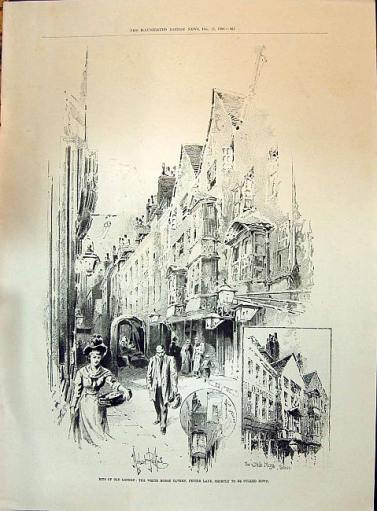
“In that prosaic room, in that very ordinary pub, was going on the most advanced thinking in this country. When lists are made of the best British writers since the war, they do not include Arthur C Clarke, nor Brian Aldiss, nor any of the good science fiction writers. It is conventional literature that has turned out to be provincial.”
— Doris Lessing, commenting on a visit to The White Horse [*] gathering circa 1952, in volume 2 of her autobiography
The White Horse in 1896: 50 years before fans arrived
[*] the London Circle of sf fans gathered at The White Horse in Fetter Lane — it appeared as the The White Hart in the Clarke short story collection Tales from The White Hart
Speculative fiction and new forms of art and storytelling and innovations in technology and computing are engaged in the work of mad scientists: testing future ways of living and seeing before they actually arrive. We are the early warning system for the culture. We see the future as a weatherfront, a vast mass of possibilities across the horizon, and since we’re not idiots and therefore will not claim to be able to predict exactly where lightning will strike – we take one or more of those possibilities and play them out in our work, to see what might happen. Imagining them as real things and testing them in the laboratory of our practice – informed by our careful cross-contamination by many and various fields other than our own — to see what these things do.
I’ve got news for you—the history of the Star Wars galaxy is precisely that. Jedi versus Sith, for thousands upon thousands of years, locked into a war they created for themselves and never seem capable of eradicating. The Sith are gone in name, but the Knights of Ren remain. Someone has to stop them… but maybe that someone shouldn’t be a Jedi.
Cinephiles, rejoice! Criterion Collection will be adding a major science-fiction classic to its roster [July 18th]: a restored version of Stalker, directed by Solaris filmmaker Andrei Tarkovsky.
Based off the 1971 Russian science-fiction novel Roadside Picnic by Arkady and Boris Strugatsky, Stalker was originally released in 1979. The film follows a man known as “the Stalker” as he leads an expedition into a mysterious, forbidden area known as “The Zone.” In the book, the mysterious Zone is the location of an alien visitation decades before the story, littered with fantastic pieces of technology and dangers; in the film, its origins are more obscure. But in both cases, reality there is distorted, and somewhere inside is a room that will grant visitors’ innermost desires. The journey to get there is physically and philosophically arduous, and it tests the trio of men traveling there.
You must be logged in to post a comment.