
Lem predicts E-books & tablets in 1961

Stanisław Lem was probably the first sci-fi writer to accurately predict the end of paper books and the arrival of electronic formats and e-book readers. He did so in his 1961 novel A Return from the Stars, some 40 years ahead of any first attempts with e-paper.

I spent the afternoon in a bookstore. There were no books in it. None had been printed for nearly half a century. And how I have looked forward to them, after the micro films that made up the library of the Prometheus! No such luck. No longer was it possible to browse among shelves, to weigh volumes in hand, to feel their heft, the promise of ponderous reading. The bookstore resembled, instead, an electronic laboratory. The books were crystals with recorded contents. They could be read with the aid of an opton, which was similar to a book but had only one page between the covers. At a touch, successive pages of the text appeared on it.

More about things predicted by Lem in the article from culture.pl http://culture.pl/en/article/13-things-lem-predicted-about-the-future-we-live-in

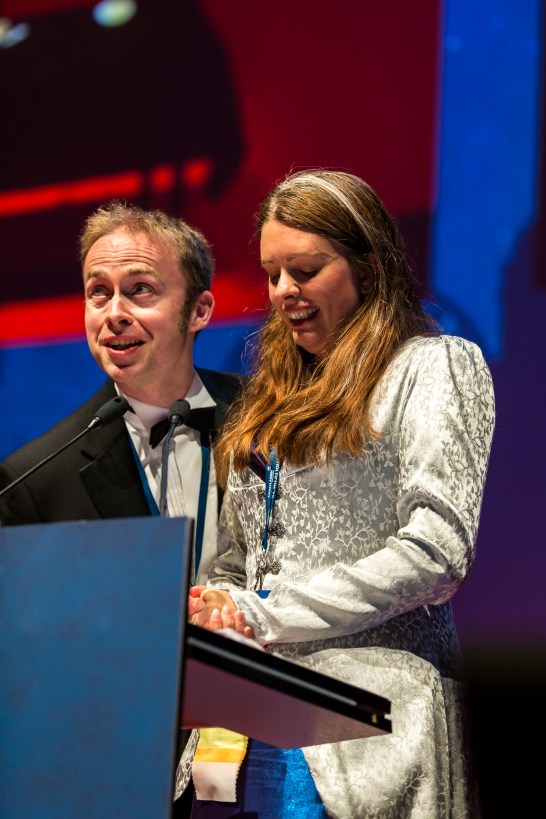
Hugo Award winners 2017

DSC_4259
The big group photo of all the participants in Hugo Award Ceremony.
Photographer: Henry Söderlund

Worldcon 75 announced the 2017 Hugo Award winners. 3,319 votes were cast on the final ballot. Two reports are available with the full statistics for the final and nominating ballots. The other reports by the Hugo Administrator 2017 are available elsewhere on the worldcon75 website

Best Novel The Obelisk Gate, by N. K. Jemisin (Orbit Books)

Best Novella Every Heart a Doorway, by Seanan McGuire (Tor.com publishing)

Best Novelette “The Tomato Thief”, by Ursula Vernon (Apex Magazine, January 2016)

Best Short Story “Seasons of Glass and Iron”, by Amal El-Mohtar (The Starlit Wood: New Fairy Tales, Saga Press)

Best Related Work Words Are My Matter: Writings About Life and Books, 2000-2016, by Ursula K. Le Guin (Small Beer)

Best Graphic Story Monstress, Volume 1: Awakening, written by Marjorie Liu, illustrated by Sana Takeda (Image)

Best Dramatic Presentation (Long Form) Arrival, screenplay by Eric Heisserer based on a short story by Ted Chiang, directed by Denis Villeneuve (21 Laps Entertainment/FilmNation Entertainment/Lava Bear Films)

Best Dramatic Presentation (Short Form) The Expanse: “Leviathan Wakes”, written by Mark Fergus and Hawk Ostby, directed by Terry McDonough (SyFy)

Best Editor – Short Form Ellen Datlow

Best Editor – Long Form Liz Gorinsky

Best Professional Artist Julie Dillon

Best Semiprozine Uncanny Magazine, edited by Lynne M. Thomas & Michael Damian Thomas, Michi Trota, Julia Rios, and podcast produced by Erika Ensign & Steven Schapansky

Best Fanzine Lady Business, edited by Clare, Ira, Jodie, KJ, Renay, and Susan

Best Fancast Tea and Jeopardy, presented by Emma Newman with Peter Newman

Best Fan Writer Abigail Nussbaum

Best Fan Artist Elizabeth Leggett

Best Series The Vorkosigan Saga, by Lois McMaster Bujold (Baen)

John W. Campbell Award for Best New Writer Ada Palmer (1st year of eligibility)

SF & Fantasy at Cinémathèque

Look out for these films as part of the Cinémathèque season at the Mercury Cinema:

  • Special 4K restoration of Besson’s Fifth Element 7pm Mon 4th Sept
  • David Cronenberg’s Existenz 7pm Mon 11th Sept
  • Wim Wenders Faraway, So Close
     — the sequel to Wings of Desire —7pm Thurs 2nd Nov
  • Howard Hawkes’ His Girl Friday —
    a gender switch on The Front Page — 7pm Mon 6th Nov
  • The awesome Casablanca — 7pm Mon 13th Nov

Superman vs the KKK

Having convinced a “Klavern” in Atlanta, Georgia that he shared their bigoted views, Kennedy donned the ominous attire of a Klansman, attended cross burnings, and covertly collected information about the group that he would then share with law enforcement and media. Radio journalist Drew Pearson would read the names and minutes of their meetings on air, exposing their guarded dialogues.

Revealing their closed-door sessions was a blow—one that Kennedy didn’t necessarily have to confine to nonfiction. In 1946, Maxwell, who produced the Superman radio serial broadcast around the country, embraced Kennedy’s idea to contribute to a narrative that had Superman scolding the racial divisiveness of the Klan and airing their dirty laundry to an enraptured audience.


In “Clan of the Fiery Cross,” a 16-part serial airing in June and July of 1946, Superman opposes an organized group of hatemongers who target one of Jimmy Olsen’s friends. Exploring their network, Clark Kent uncovers their secret meetings and policies before his alter ego socks the “Grand Scorpion” in the jaw. The idea, Kennedy wrote in his account of his work, “The Klan Unmasked, was to made a mockery of their overblown vernacular.
— excerpt from How Superman Helped Foil the KKK at Mental Floss

Aldiss dies in his sleep at 92

[Brain Aldiss] began publishing his stories in the mid-1950s, a time when SF was heavily dominated by US writers schooled in the markets of commercial magazines. Aldiss’s work came as a breath of fresh air to a genre beginning to suffocate in its own orthodoxies. He wrote lively, intelligent prose, shot through with subversive humour, linguistic novelty and human observation. He took for his subjects the full range of modern scientific research. As well as the exact sciences, he also plundered speculative, psychological, sociological and sexological areas of inquiry. One of the most exhilarating aspects of reading Aldiss is the diversity of his imagination.
— from Chris Priest’s Obituary for Brian Aldiss in the Guardian

There’s a more personal reflection on Chris Priest’s blog

Confessions of an SF addict

For the next month or so (for that matter, for the next four years, off and on), I spent some part of every weekend at the Hardings’. I don’t remember much about conversations, except that they were largely about music. Lee assured me that every time he tried to talk about sf I’d talk about Thomas Hardy or Thomas Love Peacock. Sometimes we got onto philosophy, and this proved my undoing. One night he gave me a paperback and said, ‘There: you’re pretty hot on theology (I had, in fact, spent a couple of years in theological college) – read that story and tell me what you think of it.’
So I took the book out onto the verandah, and read Arthur C Clarke’s THE STAR. And the foundations of my antipathy to sf began to crumble. Here was as fine a dramatic presentation of a theological difficulty as I had ever come across, as a story, and as stimulus to thought, it was first-rate.
—  A WAY OF LIFE The Confessions of an SF Addict, John Bangsund,
from  Apastron 1, published for the 1968 Easter SF Conference. 

Full article reprinted in Leigh Edmond’s iOTA 9, a work in progress on a history of SF fandom in Australia pre 1975. Worth a read, as the issue also includes a convention review by John Foyster, Lee Harding’s notes on Ursula K LeGuin’s visit to Sydney and Denis Stock’s piece about Arthur C Clarke’s visit to Brisbane.

Arthur C Clarke Award 2017

The Arthur C. Clarke Award for science fiction literature has announced its 2017 winner.

The Underground Railroad, Colson Whitehead (Fleet)
The winner received a prize of £2017.00 and the award itself, a commemorative engraved bookend.

The complete shortlist was:

A Closed and Common Orbit, Becky Chambers (Hodder & Stoughton)
Ninefox Gambit, Yoon Ha Lee (Solaris)
After Atlas, Emma Newman (Roc)
Occupy Me, Tricia Sullivan (Gollancz)
Central Station, Lavie Tidhar (PS Publishing)
The Underground Railroad, Colson Whitehead (Fleet)

The Orville: new SF show from Fox

THE ORVILLE is a one-hour science fiction series set 400 years in the future that follows the adventures of the U.S.S. Orville, a mid-level exploratory vessel. Its crew, both human and alien, faces the wonders and dangers of outer space, while also dealing with the familiar, often humorous problems of regular people in a workplace…even though some of those people are from other planets, and the workplace is a faster-than-light spaceship. In the 25th century, Earth is part of the Planetary Union, a far-reaching, advanced and mostly peaceful civilization with a fleet of 3,000 ships.

Fox showed this version of their trailer for The Orville at Comic-Con:


While we’re at it, here’s the trailer for the new Star Trek series, Discovery,  on NetFlix