‘‘I consider most of my work science fiction, even the stories that look like fantasy. To me, what makes a story science fiction is not whether the universe has the same laws as our universe or not, but whether it is a universe in which the scientific method works. That is a more interesting distinction for me. By that criterion, ‘Exhalation’ is a science fiction story, even though its universe bears no resemblance to ours. The same is true for ‘72 Letters’, and for ‘Tower of Babylon’.
‘‘’Exhalation’ is about conceptual breakthrough (to use the term from The Science Fiction Encyclopedia). It’s a way of describing scientific discovery and the experience of gaining a greater understanding of the universe. Recapturing the experience of conceptual breakthrough, dramatizing that, is one of the things science fiction is good at. You can just as easily do that in a completely made-up universe with a totally different set of physical laws. The underlying process is the same, and I still think of it as scientific investigation.”
Perry Middlemiss on two 2020 novels of Australian futures: Of birds and beasts!
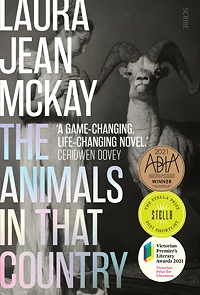
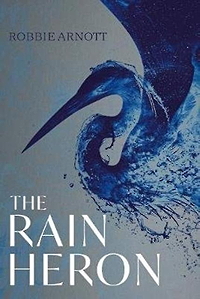
The Animals in that Country, by Laura Jean McKay and The Rain Heron, by Robbie Arnott
THE ANIMALS IN THAT COUNTRY, by Laura Jean McKay
2021 Victorian Premier’s Literary Award for Literature – Winner
2020 Aurealis Awards’ Best Science Fiction Novel – Winner
2021 ABIA Small Publishers’ Adult Book of the Year – Winner
2021 ALS Gold Medal – Short-listed 2021 Arthur C. Clarke Award – Short-listed
2021 Miles Franklin Literary Award – Long-listed
2021 The Kitchies’ Golden Tentacle Award – Short-listed
2021 The Stella Prize – Short-listed
2021 Victorian Premier’s Literary Award for Fiction – Winner
2020 The Readings Prize for New Australian Fiction – Short-listed
“As disturbing news arrives of a pandemic sweeping the country, Jean realises this is no ordinary flu: its chief symptom is that its victims begin to understand the language of animals — first mammals, then birds and insects, too. As the flu progresses, the unstoppable voices become overwhelming, and many people begin to lose their minds, including Jean’s infected son, Lee. When he takes off with Kimberly, heading south, Jean feels the pull to follow her kin.
“Setting off on their trail, with Sue the dingo riding shotgun, they find themselves in a stark, strange world in which the animal apocalypse has only further isolated people from other species.”
💥 💥 💥
THE RAIN HERON, by Robbie Arnott
Shortlisted, Miles Franklin Literary Award, 2021
Shortlisted, ALS Gold Medal, 2021
Shortlisted, Small Publishers’ Adult Book of the Year, 2021
Shortlisted, Age Book of the Year, 2021
Longlisted, Not the Booker, United Kingdom, 2020
“The Rain Heron is set in an unidentified country in which a military coup has recently occurred. The first section of the novel proper (the opening story is headed ‘Part 0’, placing it outside the main narrative structure) is told from the point of view of a woman named Ren, who has retreated into the wilderness. She lives alone in a cave on a remote mountainside, where she subsists by hunting and foraging and growing a few vegetables, occasionally venturing into the lowlands to barter with a fur trader and his son.
“One day she encounters some soldiers, who are searching the mountainside for the mythical rain heron. Their leader, the efficient and cunning Lieutenant Zoe Harker, questions Ren about the bird’s whereabouts, but Ren denies all knowledge…”
Topic: Nova Mob 1 Sep: Perry Middlemiss on Australian Futures Time: Sep 1, 2021 8 PM Canberra, Melbourne, Sydney; 7:30pm Adelaide
J. Michael Straczynski told Facebook readers August 12th that The Last Dangerous Visions has been finished.
THE LAST DANGEROUS VISIONS has at last been completed. The final draft went off to the agency that will be handling the sale about fifteen minutes ago. This has been a massive effort…112,000 words…tracking down the estates of the original writers to be included in the book, and nailing down some newer A List writers; fans of Harlan’s who wanted to be a part of TLDV. (And for the record, Harlan continued to buy stories for the anthology right through the 90s, and stopped only due to illness. He saw TLDV as a living document, and fought to keep it relevant when some stories became less timely or were supplanted by real world events.)
I will have more to say about the contents at a later date, but suffice to say that they include some of the most visionary writers in the science fiction genre over the last 48 years.
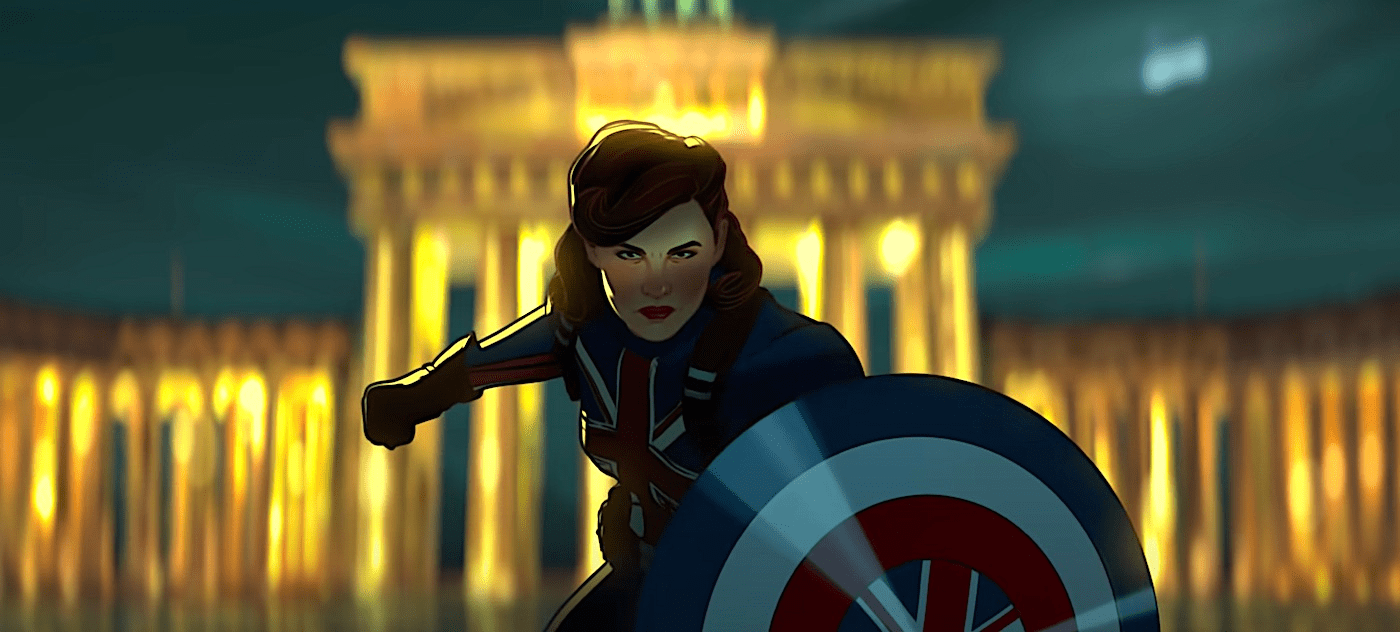
Marvel’s new What If…? animated series takes us back to the beginning with a rewrite of Captain America: The First Avenger. In this version, it’s Peggy Carter who takes up the Mighty Shield—and the shield has a Union Flag on it.
I have to say I think this is the most pure fun I’ve had watching any of the Disney Marvel series so far?
— The Sheer Bloody Fun of What If…? “Captain Carter Were The First Avenger” by Leah Schnelbach at tor.com
The novel is usually regarded as a realist art form, and I’d go even further: By telling the stories we use to understand our lives, the novel helps create our reality. In novels, things go wrong—that’s plot. People then cope. That’s realism.
Utopia, on the other hand, is famously “no place,” an idealized society sometimes described right down to its sewage system. In utopia, everything works well—maybe even perfectly, but for sure better than things work now. So utopias are like blueprints, while novels are like soap operas. Crossing these two genres gets you the hybrid called the utopian novel: soap operas put in a blender with architectural blueprints. It doesn’t sound all that promising.
Then came Ursula K. Le Guin’s The Dispossessed. Published in 1975, this was the first great utopian novel, and it demonstrated just how good the poor, misbegotten hybrid can be. Of course, there’d been earlier utopian novels, like William Morris’s News From Nowhere, or H.G. Wells’sA Modern Utopia, or Charlotte Perkins Gilman’sHerland, or Aldous Huxley’s Island. These were all interesting efforts. But Le Guin’s book was a triumph. What she showed is that by describing a utopian society in a moment of historic danger, you create for it all kinds of problems that its characters must solve. It will get attacked from the outside, corrupted from the inside; things will go wrong, and so you have your plot. Le Guin combined an intriguing utopia with a compelling novel, and the result was superb. The people on her habitable moon, Annares, have formed an alternative society to the imperial capitalist world, Urras. They devised a system that is feminist for sure and either democratic socialist or anarcho-syndicalist, but in any case in a state of flux, its people doing everything they can to keep what’s best about their system while also fending off impositions from the home world. It’s political fiction at its best.
— “The Novel Solutions of Utopian Fiction,” Kim Stanley Robinson, The Nation, Aug 2nd
As was mentioned at the last Critical Mass, fanac.org have a channel at youtube.com. One of the interesting items was a slideshow from the 1964 Worldcon, featuring Fritz Leiber talking about Monsters and Monster Lovers.
The 2021 Cattitude Bundle, curated by Kristine Kathryn Rusch:
Cats. The internet loves them because we love them. We love cats in all their incarnations—playful, magical, irritating, and yes, occasionally evil. This StoryBundle explores the range of cats and cat behaviors as well. From the familiars to winged space cats, from cats who facilitate romance to cats who rescue others, every type of cat appears in this StoryBundle. Perfect for a day at the beach (without a cat) or at home in the AC (with cats nearby).
There are 10 books (four StoryBundle exclusives!) in the bundle :
The books in the Storybundle
More details at StoryBundle — Note: available until 18th August
The 2021 judges are Phoenix Alexander, Nicole Devarenne, Stewart Hotston, Nick Hubble, and Alasdair Stuart, with Andrew M. Butler serving as the non-voting Chair of the Judges. The shortlist was selected from 105 titles submitted by 41 individual UK publishing imprints and independent authors. The winner will be announced in an award ceremony in September. For more information, see the Clarke Award website. (with thanks to Locus).
Well known for his Fafhrd and the Grey Mouser stories, and for inventing the term “sword and sorcery”.
(1910-1992) US author, his work runs the gamut from sf through fantasy and horror, with many tales achieving an eloquent Equipoise that enabled him to jostle various genres together, riding them with a freedom unusual for the period of their composition, making him a powerful model for later writers.
Well known for his Fafhrd and the Grey Mouser stories, and for inventing the term “sword and sorcery”.
His awards and honours speak for themselves:
· Guest of honour at World Science Fiction Convention, 1951, 1979;
· Hugo Award, World Science Fiction Convention, for best novel, 1958, for The Big Time, and 1965, for The Wanderer, for best novelette, 1968, for “Gonna Roll the Bones,” for best novella, 1970, for “Ship of Shadows,” and 1971, for “Ill Met in Lankhmar,” and for best short story, 1975, for “Catch That Zeppelin”;
· Nebula Award, Science Fiction Writers of America, for best novelette, 1968, for “Gonna Roll the Bones,” for best novella, 1971, for “Ill Met in Lankhmar,” for best short story, 1975, for “Catch That Zeppelin,” and Grand Master, 1981, for lifetime contribution to the genre;
· Ann Radcliffe Award, Count Dracula Society, 1970;
· Gandalf Award, World Science Fiction Convention, 1975;
· August Derleth Fantasy Award, 1976, for “Belsen Express”;
· World Fantasy Award, World Fantasy Convention, for best short fiction, 1976, for “Belsen Express,” and for best novel, 1978, for Our Lady of Darkness;
· World Fantasy Life Award, World Fantasy Convention, 1976, for life achievement;
· Locus Award, best collection, 1986, for The Ghost Light;
Somewhere, 39 completed, official episodes of a Star Wars television show exist. A show George Lucas helped create. A show with Darth Vader, Han Solo, Obi-Wan Kenobi, and more. And yet, according to the show’s co-creator, odds are we’ll never get to see any of it. That show is called Star Wars Detours and it was announced back in 2012. Co-created by the Robot Chicken team of Seth Green and Matthew Senreich, Detours was an officially licensed Star Wars animated comedy using characters from all the films up to that point. Lucas himself even gave his approval and consulted with Green and Senreich on the show. Brief glimpses were released (as well as a description Gizmodo truly trashed at the time), but when Disney purchased Lucasfilm soon after the announcement, the show was shelved awaiting further actions. Now, in a new interview with Entertainment Weekly, Green says that’s kind of where things still are almost a decade later.

Read the complete interview, and biographical profile, in the July 2011 issue of Locus Magazine.


You must be logged in to post a comment.