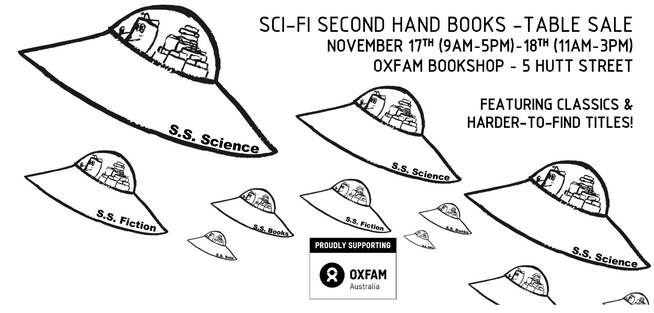
Our source at Oxfam tells us that they’ve recently acquired a large volume of books from an sf collection in melbourne, and they go on sale this weekend!
fans of sf, fantasy, horror & whimsy

Our source at Oxfam tells us that they’ve recently acquired a large volume of books from an sf collection in melbourne, and they go on sale this weekend!
A broad church
Perhaps what counts as speculative fiction is also changing. The term is certainly not new; it was first used in an 1889 review, but came into more common usage after genre author Robert Heinlein’s 1947 essay On the Writing of Speculative Fiction.
Whereas science fiction generally engages with technological developments and their potential consequences, speculative fiction is a far broader, vaguer term. It can be seen as an offshoot of the popular science-fiction genre, or a more neutral umbrella category that simply describes all non-realist forms, including fantasy and fairytales – from the epic of Gilgamesh through to The Handmaid’s Tale.
Read more: Guide to the classics: the Epic of Gilgamesh
While critic James Wood argues that “everything flows from the real … it is realism that allows surrealism, magic realism, fantasy, dream and so on”, others, such as author Doris Lessing, believe that everything flows from the fantastic; that all fiction has always been speculative. I am not as interested in which came first (or which has more cultural, or commercial, value) as I am in the fact that speculative fiction – “spec-fic” – seems to be gaining literary respectability. (Next step, surely, mainstream popularity! After all, millions of moviegoers and television viewers have binge-watched the rise of fantastic forms, and audiences are well versed in unreal onscreen worlds.)
One reason for this new interest in an old but evolving form has been well articulated by author and critic James Bradley: climate change. Writers, and publishers, are embracing speculative fiction as an apt form to interrogate what it means to be human, to be humane, in the current climate – and to engage with ideas of posthumanism too.
These are the sorts of existential questions that have historically driven realist literature.
— excerpt from Rose Michael’s essay “How Speculative Fiction Gained Literary Respectability” in The Conversation Nov 2nd
The British Fantasy Society has announced the winners for the 2018 British Fantasy Awards:
Best Fantasy Novel (the Robert Holdstock Award)
- WINNER: The Ninth Rain, Jen Williams (Headline)
Best Horror Novel (the August Derleth Award)
- WINNER: The Changeling, Victor LaValle (Spiegel & Grau)
Best Novella
- WINNER: Passing Strange, Ellen Klages (Tor.com Publishing)
Best Short Story
- WINNER: “Looking for Laika”, Laura Mauro (Interzone 11-12/17)
Best Collection
- WINNER: Strange Weather, Joe Hill (Gollancz)
Best Anthology
- WINNER: New Fears, Mark Morris, ed. (Titan)
Karl Edward Wagner Award
- N.K. Jemisin
Winners were chosen by jury, except for the special award (the Karl Edward Wagner Award), which was chosen by the BFS committee. Winners were announced during an awards ceremony at FantasyCon 2018, held October 19-21, 2018 at the Queen Hotel in Chester, England.
— from Locus magazine, which includes runners up and details of several media awards.
We invite you to look at the list produced for the 1975 meeting of the Nova Mob. If we were producing such a list today, what would feature?
Come along to Kappy’s, 6:45 for a 7pm start, with your comments on the list provided.
The first meeting of the Nova Mob for 1975, on Jan 2nd, discussed the Basic Science Fiction Library.
They started by considering the List from Lee Harding.
Basic for whom? Anyone, when pressed, should be able to name their favourite (12) sf books. This has not been my intention. I have chosen a list of titles I would recommend to anyone not yet acquainted with the genre – in particular schools and other libraries — and i would use all or any one of them to convert educated readers to sf. My intention has been to produce a short list of relatively permanent value: one that will not be made unfashionable by social progress of literary pretentiousness. So: a Basic Library of SF for all time (one hopes):
- Earth Abides George R Stewart. The definitive catastrophe novel; well-written and, in this respect, well ahead of the competition.
- Tiger! Tiger!* Alfred Bester. The best example of what has been loosely termed ‘wide-screen baroque sf’, and easily the most entertaining sf novel ever written. [* also known as The Stars My Destination]
- The Silver Locusts* Ray Bradbury. He has his detractors, and no one will deny that his later work, chocolate fudge and all, has tarnished a reputation that once burned brighter than any other sf star. But time cannot efface the weird lyricism of these tales. They helped sf to take a giant leap into literature and influenced a generation of writers. It is good to reflect on that.
[* aka The Martian Chronicles]- Space Lords Cordwainer Smith. His unique vision of a far-out future deeply reflecting our past hardly needs any introduction. These stories seem to best typify his remarkable output… but it’s hard to choose.
- Hot House Brian Aldiss. Chosen to best represent the far, far, future sub-genre. Aldiss’ apocalyptic vision of a world gone mad with vegetation is surely one of the most extravagant in all sf.
- The Science Fiction Hall of Fame ed Robert Silverberg. This is volume 1 of the series, but any one of them will suffice. The more one digs into the sf past the more it becomes apparent that the best material has been under novel length…
- Cities in Flight James Blish. The one volume Avon edition, naturally. Of all the so-called ‘epics’ of sf, this one seems to me the most satisfying. Blish’s imagination continues to soar when lesser writers give out, and his prose remains constantly readable where, say, the Asimov of Foundation time hasn’t aged at all well.
- The Nine Billion Names of God Arthur C Clarke. When it came to selecting a one-author collection, Clarke’s seemed the one best suited to display the short storey medium. he has the hard-science approach of many of is compatriots — Anderson, Clement, Niven, etc. — but blended with the gentle poetry I have been convinced best represents a ‘sense of wonder’.
- The Man in the High Castle Philip K Dick. A fine, smoothly-written novel that best typifies the sf predilection of playing with alternative possibilities. Quiet, moving and richly detailed; possibly the best book Dick has done.
- The Sirens of Titan Kurt Vonnegut. Chosen because it is such a damn fine book — probably the only one to match Tiger! Tiger! for sheer entertainment.
- The Paradox Men Charles L Harness. Sorry, but I just had to slip this one in. It overlaps with the bester book — both being superior examples of wide-screen baroque. But it has so many brilliant passages that cry out for examination and appreciation that I had to put it in.
- The Short Stories of H G Wells This needs no special reading: here a re just about all the plot elements of every sf story you have ever read. Wells was a master story teller, then and now. I know of mo better way to begin an odyssey into short story sf than this marvellous volume.
Well, there it is. One final word: my selections have been soundly based on availability of the works mentioned. Bearing in mind the basic premise of the above library, I feel this is essential.
Have fun,
Lee Harding
—— from John Foyster’s Nova Mob Leaflet, Jan 1975, reproduced by Bruce Gillespie as part of his incomplete history of the Nova Mob, *brg* 102
Here’s the complete list of nominees, with winners indicated in bold, followed alphabetically by other nominees.
N.K. Jemisin’s The Stone Sky was the odds-on winner for Best Novel since it was first published last year. N. K. Jemisin is the first writer in history to win three consecutive Hugo Awards in the Novel category.
The speech she gave was wonderful and electrifying:
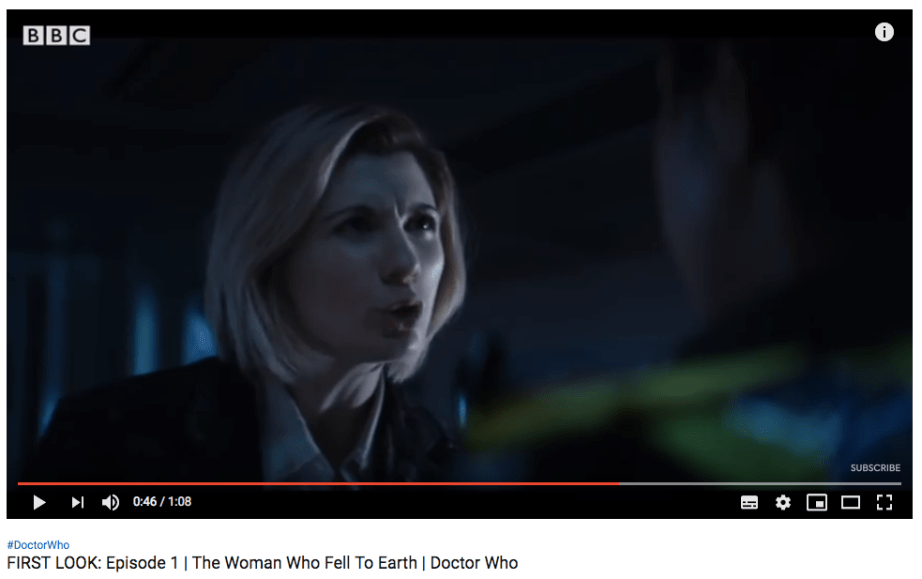 The BBC have just released the first extended clip from Doctor Who season 11’s premiere episode, “The Woman Who Fell to Earth”. While it isn’t a perfect indicator of what Whittaker’s 13th incarnation of the Doctor is going to be like — she’s still in a post-regeneration haze, unsure of who she really is or even that she’s a she now… after all, as she says, she was a white haired Scotsman not too long ago!
Engadget delves into the VR adaptation of a PKD story: “Philip K. Dick’s ‘The Great C’ for Oculus Rift arrives this October”.
The virtual reality adaptation of Philip K. Dick’s The Great C is now making its way to VR headsets after debuting at the Venice Film Festival. It will be available for the Oculus Rift and HTC Vive as soon as October 9th, but PlayStation VR owners will unfortunately have to wait until 2019. Fans can expect to be thrust into a 37-minute immersive sci-fi adventure when they put on their headsets and fire up the experience.
The Great C is a post-apocalyptic story that revolves around the remnants of humanity under the rule of an all-powerful supercomputer called “The Great C.” Every year, a human tribe living nearby has to sacrifice a young person to the machine in order to appease it. The VR adventure by Secret Location focuses on a woman named Clare whose fiancé was chosen for that particular year’s pilgrimage from which nobody ever returns.
Each month in 2018, Future Tense Fiction—a series of short stories from Future Tense and ASU’s Center for Science and the Imagination about how technology and science will change our lives— is publishing a story on a theme. This month’s entry in the Future Tense Fiction series is “Lions and Gazelles” by Hannu Rajaniemi.
— Mike Glyer, “Pixel Scroll 9/28/18 Who Put Nineteen Great Pixels In That Itty Bitty File?”, at file770.com


You must be logged in to post a comment.