DC Comics is changing what Superman stands for. The company released a new mission statement for the 83-year-old icon who famously fought for “Truth, Justice and the American Way.”
Now Clark Kent’s Man of Steel is about “Truth, Justice and a Better Tomorrow.” “To better reflect the storylines that we are telling across DC and to honor Superman’s incredible legacy of over 80 years of building a better world, Superman’s motto is evolving,” announced DC Chief Creative Officer and Publisher Jim Lee at the company’s DC FanDome fan event on Saturday. “Superman has long been a symbol of hope who inspires people, and it is that optimism and hope that powers him forward with this new mission statement.”
“I’m tired of having my actions construed as instruments of U.S. policy. ‘Truth, Justice and the American Way’ — it’s not enough anymore. The world’s too small. Too connected.”
Superman, In the 900th issue of Action Comics, when he renounced his U.S. citizenship (2011)
Ian Mond’s best books of genre not packaged as genre
Face to face meeting, simulcast in Zoom
This year Ian has selected 14 books for your reading delight. By way of suspense, one is a Nova Mob repeat, and one author appears twice. Ian’s list is well worth centring your year’s reading around.
Kensington Town Hall, 8.00pm, Wednesday 10 November, address below. Note that the event is now a week later.
We’d love to see you there, although there are restrictions as you’d expect:
– If you have symptoms associated with COVID-19, please stay at home and use the Zoom simulcast instead.
– If you are not fully vaccinated, in other words 2 jabs, please do not attend in person.
– If you don’t want to provide your proof of full vaccination along with your contact details for COVID contact tracing purposes, please do not attend in person.
If you plan to attend in person, please acquire a ticket via Eventbrite, as numbers are limited to 18.
Our Nova Mob COVID-19 Plan is being revised to fulfil Kensington Town Hall requirements under the new State Government arrangements, and for entry you will be required to provide your proof of vaccination status.
Face to face
You are invited to an in-person Nova Mob meeting at:
Wednesday 10th November
8.00pm – 9.30 pm or so, first floor Conference Room
Kensington Town Hall
30 – 34 Bellair St
Kensington Melbourne VIC 3031
By Zoom – simulcast
For those who prefer not to travel or are unable to attend face-to-face. This’ll be close to a webcast or radiocast in style, broadcast from the Kensington Town Hall. Questions or comments typed into the Zoom chat will be passed through to Ian as the opportunity permits.
We apologise in advance for any IT issues. Our knowledge is sufficient to know there will be something, but is not deep enough to pinpoint what it’ll be this time.
As discussed at the August meeting last week, Critical Mass will be having a look at online SF mags We invite members to have a look at two of the four magazines nominated for each month: please peruse two months worth of “issues” before the relevant meeting
We were to host a breakout room on zoom after the ASFF awards ceremony (Oct 29th) to stage a reading of the 1863 The Burlesque of Frankenstein. Unfortunately, the ASFF has reorganised their event and now won’t have space for the reading.
After some discussion, we decided to defer the event until early next year, so there’s still a chance for you to catch the event. If you’re interested in taking part, have a look at the Notes and text of the Burlesque, and let Roman know which part you are interested in.
Murray notes: As our lockdown continues and Victoria opens up on the modelling that it’ll be a 50/50 coin-toss whether or not our hospitals get overwhelmed, I’m hoping that your spirits are well and you and your friends and family are reaching out to each other with care and fun.
Here’s some fun! Paul Voermans is our guest at the Nova Mob on Wednesday 6 October!
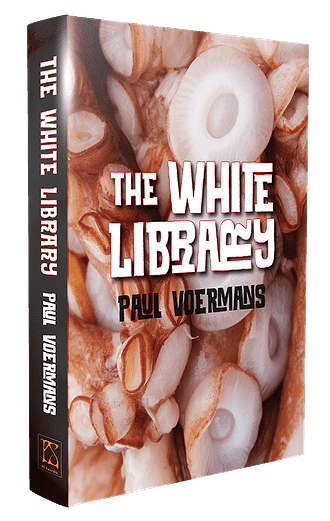
Paul will be telling us about his latest novel, 2020’s The White Library. It is highly likely that byways and tangents of sfnal, surrealist and fannish interest may be pointed at, explored, and poked with sticks.
“the novel is a joy to read, brimming with wild ideas, vibrant characters and a cinematic, sense-of-wonder denouement” — Ian Mond, in Locus
Paul says, “I’ve attended a few Nova Mobs in my day, but I assume that this one will not include attending a restaurant in Richmond! I suspect that dates me….”
In truth it dates all of us because that was pre-pandemic. Our meeting will be by Zoom, invitation below, but first the calendar:
Calendar
Sep 28 – Nova Mob Special 1-hour meeting: Clarke Awards announcement.
Oct 6 – Paul Voermans on The White Library.
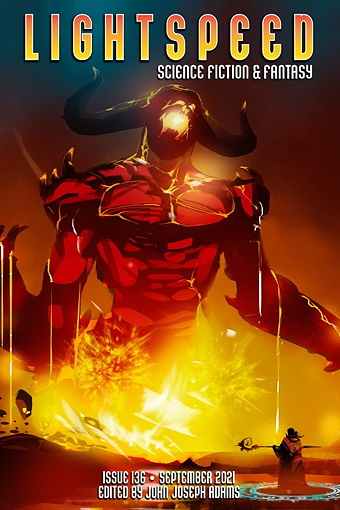
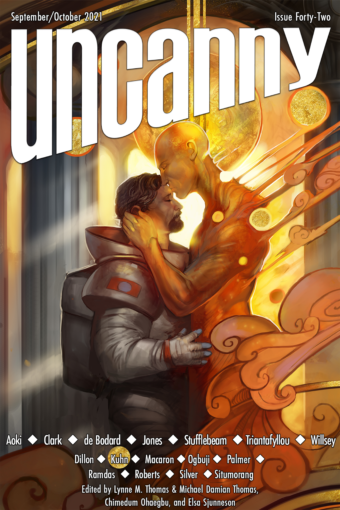
Oct 27 – Critical Mass Adelaide – Online SF Magazines Lightspeed, Escape Pod, Uncanny.
Oct 29 – Australian Science Fiction Foundation Awards Night with Nova Mob party room.
Nov 3 – Ian Mond – 2021’s ten best books of SF interest not branded as SF.
Nov 27 – Critical Mass Adelaide – Roman Orszanski on Empires, Galactic and Magic.
Dec 1 – Iain McIntyre – Dangerous Visions and New Worlds: Radical Science Fiction, 1950 to 1985 by Andrew Nette and Iain McIntyre.
Dec 18 – end of year Nova Mob lunch hopefully face to face. To be confirmed, it’s subject to pandemic restrictions and requirements.
💥 💥 💥
Meeting: Paul Voermans on The White Library (2020)
You are invited to a scheduled Zoom meeting of the Nova Mob.
Date and Time: Oct 6, 2021 8:00pm Canberra, Melbourne, Sydney, 7:30pm Adelaide
Paul speaks from about 8.10pm to around 9.00pm followed by questions and discussions. Formal close after discussions, say 9.20pm, and final close for those who wish to linger and chat will be at or before 10pm.
Solarpunk is an artistic and cultural movement that encompasses, but isn’t limited to, areas such as art, technology, architecture, fashion, film, cuisine, and of course literature. From a literary perspective, it’s a subgenre of science fiction that was born out of, and perhaps is the next logical step after, cyberpunk. Solarpunk stories take place in futures where humanity, technology, and nature live in harmony rather than in conflict. Often, solarpunk stories deal with hypothetical technological innovations that help humanity avert or creatively adapt to climate change. And while solarpunk tales don’t necessarily take place in utopias, they are definitely not dystopias. Rather, they are overflowing with hopeful characters and communities optimistically striving to create a new and better world.
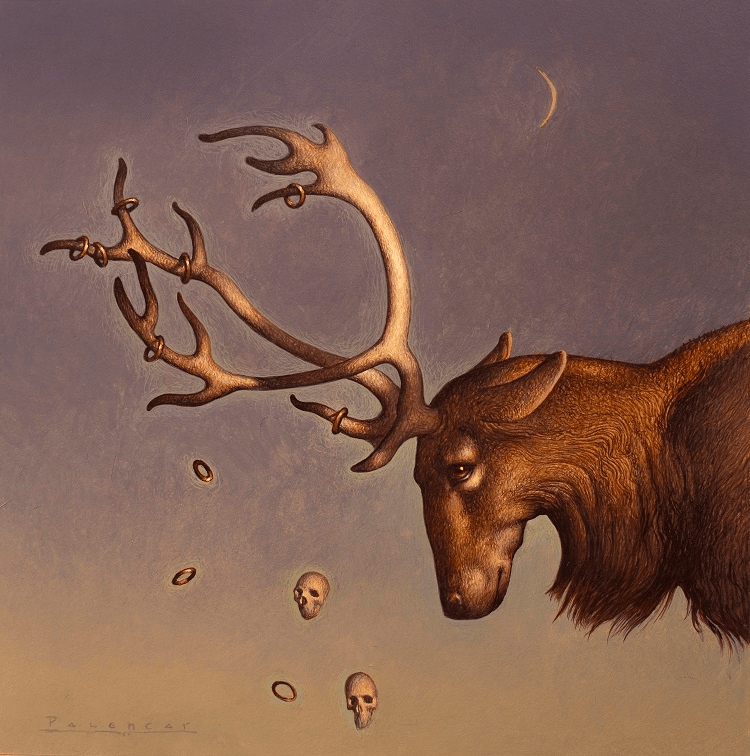
And courtesy Tor.com: Free Read From Kathleen Jennings: In a fairy tale equal parts gorgeous and gruesome, village couples seek approval for marriage from a stag with golden rings adorning its horns. That is until one suitor, determined to convince a woman to fall in love with him, makes a rash decision.
We would like to invite you to our Awards and After-Party on the 29th October. The invitation is below. This promises to be a fun night and an opportunity for everyone to reconnect and celebrate the ASFF in a safe and supportive environment. Don’t forget to RSVP admin@asff.org.au
Melbourne’s State Library is the setting for Paul Voerman’s third full-length published novel, The White Library.
What’s the weirdest thing you could imagine going on in a national library?
Dropout physics student Angela Donohoe is about to discover just that. Release it. Become it. All in a world where colonial history did not quite turn out like ours, where the global power is the Federated Kingdom of Mendana and David Bowie was an astronaut, The White Library is a surreal escapade of library friends and enemies, love—and a remarkable woman.
It’s also a slightly sideways sequel-by-association to Paul’s The Weird Colonial Boy. Says Paul:
“Unlike the faithful, who have ordered copies and even circulated them among poverty-stricken friends, I’m not expecting people to have forked out for a hardcover at about $65 including delivery from the UK and we are still working on the Australian distribution, so the link to the very reasonable e-book is https://www.pspublishing.co.uk/the-white-library-ebook-by-paul-voermans-5316-p.asp Only GBP 2.99! Please feel free to forward this to anybody you think might like a foolish SF novel set in the State Library of Victoria.”
[I’ve bought the e-book and it worked out at AU$5.89 — I received the email link within five minutes and had a choice of mobi or epub ]
Nick Mamatas suggested a bundle looking at that nebulous concept, the “singularity”, and I thought it would be fun to take a wide-ranging approach to it, encompassing the post-human, A.I., space opera and much more. […]I love the variety of novels and authors in this bundle.
And what is the Singularity anyway? A silly hypothetical concept beloved by the neo-libertarian tech rich? A utopian vision? A dystopian one? Or is it a convenient shorthand for the possible convergence of human and machine that we already have?
The fun is in the asking. And I think each of the authors here grapple with some fundamental questions about human and others and our place in the universe. And, you know – they’re also terrific fun!
A Note About The Charity
I thought this being a hard SF-ish bundle, it would be appropriate to nominate as my charity of choice the Locus Foundation. Locus Magazine was established in 1968, and became the single most important news source for the SF/F field, offering unparalleled cover, in-depth reviews and author interviews, and so much more. […] Times are hard for everyone right now, and this seems a good cause to support! – Lavie Tidhar
* * * Note the bundle will be available online here until the 15th October * * *



You must be logged in to post a comment.