 Science fiction its modern sense can be said to have begun in April 1926, with the publication of the first issue of Amazing Stories, under the editorship of Hugo Gernsback. Certainly genre magazine science fiction started then in the sense of having a magazine dedicated to science fiction stories. Previously science fiction had appeared across a wide range of magazines and publications, Amazing Stories was the first magazine to specifically concentrate on publishing science fiction. This is a somewhat controversial position as there are other reasonable origins for the field of science fiction. History is rarely simple.
For example, Gernsback was promoting what he called “scientifiction” and not “science fiction”. Soon his scientification would become better known as science fiction. I had always assumed that stf (the abbreviation for scientifiction) was soon replaced by the easier to say science fiction, asnd this happened as early as the 1930’s. Recently when I was skimming through issues of science fiction magazines from the nineteen-forties and nineteen-fifties I found a 1952 issue of, what may have been, Startling Stories promising that it delivered the “Best in Scientifiction” for its readers. This wasn’t a single instance, scientifiction hung around around longer than expected. So, stf as a term was still in currency nearly twenty-seven years after the first Amazing Stories. Other magazines of around the same time were also claiming to publish scientifiction, but, of course, not all. Magazines like Astounding, Galaxy, and, naturally, the Magazine of Fantasy and Science Fiction clearly saw themselves as venues for science fiction.
Amazing Stories, while it was the first dedicated science fiction magazine, it wasn’t the first pulp science fiction magazine. Pulp magazines were cheap, mass circulation magazines using poor quality paper. The magazines in Gernsback stable of publications, Gernsback was first and foremost a publisher of technical magazines for popular consumption. The titles of which appear at the bottom of the cover page. These weren’t pulp magazines, so neither was Amazing Stories. The honour for the first pulp science fiction magazine goes to Astounding Stories of Super-Science which was first published in 1929, which was, according to my investigations, the second science fiction magazine proper. Interestingly, Weird Tales, which is usually thought of as a magazine of supernatural fantasy and horror was also a publisher of science fiction too. A case in point Edmond Hamilton’s Interstellar Patrol series appeared in first in Weird Tales, beginning in the late 1920s.
What did Gernsback offer his readers in April 1926? A glance at the table of contents reveals the following. Beginning with the serial in two parts of Off on a Comet (Jules Verne; 1/2), The New Accelerator (H. G. Wells), The Man From the Atom (G. Peyton Wertenbaker), The Thing From—”Outside” (George Allan England), The Man Who Saved the Earth (Austin Hall), and The Facts in the Case of M. Valdemar (Edgar Allan Poe).
It’s an interesting mix of mainly reprints and a couple of new stories by writers whose fame time has extinguished. Not necessarily the strongest beginning, but science fiction was in the process of being born and it had a long to way to go before it would find its feet. However, issue number two has “The Runaway Skyscraper” by Murray Leinster. An author whose reputation hasn’t entirely been eclipsed and who continued writing for many decades afterwards. That might be a good point for the start of the road from scientifiction to what has become science fiction and which continues to transform and create itself anew right up to the right and into the future.
This began ninety years ago. So, happy anniversary, ninety years young, Amazing Stories, to the birth of one of science fiction’s many origins and the likely foundation of what science fiction culture has become.

 This is the complete collection of Doctor Englebert Esterhazy’s adventures in the Triune Monarchy of Scythia- Pannonia-Transbalkania, located in a 19th-century Europe between the Wars.


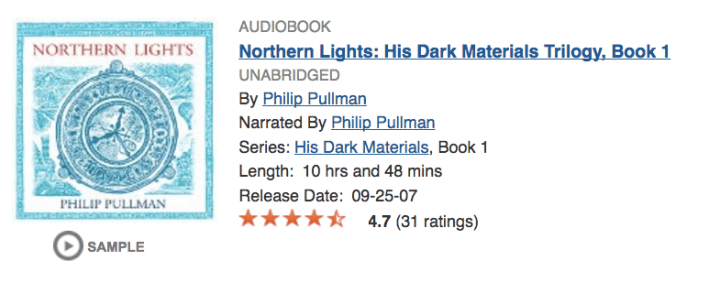 Yes, all of the His Dark Materials trilogy are available. Not only is Pullman an excellent reader of his own work, but (as with the Kushner) a full cast enlivens the narrative — the attack on the polar bear stronghold is beautifully evoked.


 The Adelaide Fan Review
You must be logged in to post a comment.