Reactor magazine recently published lists by their reviewers of best novels of 2024. Here are some of their suggestions:
The Tainted Cupby Robert Jackson Bennett—already one of my favorite authors for his Foundryside series—was everything I wanted from a fantasy murder mystery: a reclusive detective and a put-upon assistant reminiscent of the Nero Wolfe series; powerful biochemical magic; and all-too-realistic bureaucracy. And despite my love for vast, world-shattering stories like the two above, I enjoyed that The Tainted Cup wasn’t that; with this first book in the Shadow of the Leviathan series, Bennett threads the needle of setting the mystery in a sprawling world without raising the stakes too far. [Sasha Bonkowsky]
Kerstin Hall’s Asunder has slipped under a lot of radars. Written with precise and glittering prose and a deft eye for characterisation, its worldbuilding is complex and entertaining eldritch, while its protagonist keeps making terrible life choices on account of all the other ones are worse. Compelling, brilliant, weird: I will fight you for the sequel. [Liz Bourke]
Of courseMetal From Heaven by august clarke and The City in Glass by Nghi Vo are here. Their latest books were stunning literary achievements. The experience of reading these stories is as intense as the stories themselves. It felt like I was holding my breath the entire time. These books are gorgeous, lyrical, and relentless, and furious. [Alex Brown]
Kaliane Bradley’s The Ministry of Time was an unexpected read that I enjoyed—I picked it up for the deft critique of colonialism explored via the trope of time travel and stayed for the steamy relationship between the narrator and the darkly sexy 19th-century arctic explorer who becomes her roommate. Not every book is both thoughtful and entertaining, but The Ministry of Time is one of those books that knocks both out of the park. [Vanessa Armstrong]
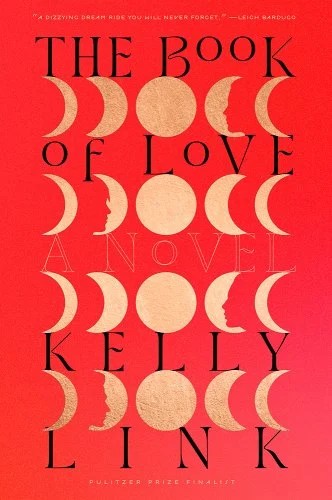
If someone asks for the definition of magic, hand them Kelly Link’s debut novel, The Book of Love. Tell them that by the end, you will not have THE definition of magic, but you will have so many beautiful definitions to choose from. Whimsical, sexy, unrelenting, oppressive, sorrowful, hilarious, real, unreal, quirky, joyous, stalwart, deadly, vicious, musical, romantic, all-powerful, quite small indeed, just a little to the right of what you’re looking at, Link lets us define magic how we want through one of my new favorite novels for life. [Martin Cahill]
Kaliane Bradley’s fantastic The Ministry of Time leans all the way into the weirdness of bringing people from the past into our current moment. Having reeled you in with the promise of time travel and kissing, it slowly reveals itself to be an immensely thoughtful story of complicity, power, and the function of individual choice within unjust systems. [Jenny Hamilton]
Ever since Méliès sent his characters to the Moon in 1902, filmmakers have never stopped making science fiction movies. From very early adaptations of the works of Mary Shelley, Jules Verne, and Arthur Conan Doyle all the way up through the juggernaut franchises we have today, from short films to weighty epics, political allegories to gee-whiz adventure stories, arthouse darlings to summer blockbusters, moody emotional ponderings to gloriously gory monster mashes, the history of cinema is inextricably linked with the genre of science fiction.
And the Reactor Science Fiction Film Club is here to explore every corner of it!
How will it work?
Once a week, one movie at a time, we’ll watch our way through the good, the bad, and the utterly bizarre in science fiction cinema. I’ll share the month’s selections ahead of time, and each Wednesday I’ll post an essay about that week’s film, including a bit about its history, context, and impact, to revel in the weird and wonderful variety of sci-fi movies out there. Everybody will be welcome to share their thoughts in comments, whether you’re watching it now for the first time or saw it years ago.
What are we going to watch?
Anything. Everything. In any language, from anywhere in the world. As long as it’s science fiction. Some of the films we watch will be masterpieces. Some of them will be terrible. Some will be both, as is often the case. Some of them will be very familiar. Some will be obscure. Some will be movies you love. Some will be movies you, personally, hate. I am going to approach all of them with an open mind, a generosity of spirit, and the goal of having fun with a century of sci-fi movie magic. (The oldest film on my list is currently Aelita (1924), so that time frame is not an exaggeration. Depending on availability we might even look at some earlier movies.) Many of the movies will be paced much more sedately than modern films, so grab a cozy blanket, pour a glass of wine, put your phone down, and relax. Space epics, time travel, claustrophobic horrors, psychological mindfucks, political satires, alien invasions, Barbarella—it’s all good
How do we watch the movies?
Everything I’m choosing is available for online streaming somewhere, because I am not going to make anybody rely on access to a dusty box of VHS tapes in their friend’s neighbor’s uncle’s attic. Sometimes it might be a bit complicated, but I will do my best to provide up-to-date information and options. How you access the films from where you live, within your budget, is between you and your VPN. I recommend checking a site like JustWatch or similar to search for availability in different regions. When in doubt: check your local library or search YouTube and the Internet Archive.
We’re going to get started in March with a selection of classics that imagine the many problems people will face when they head out to explore space. The films are listed below by the date on which the column will be published, so you can watch ahead of time and participate in the discussion.
March 6 – Forbidden Planet (1956), directed by Fred M. Wilcox A cautionary tale about packing too much Freudian psychology in your space luggage. Watch: Tubi (free), Amazon, Apple, Google Play, and several other places as well. Watch a trailer here.
March 13 – Solaris (1972), directed by Andrei Tarkovsky Famously disliked by author Stanislaw Lem but beloved by just about everybody else. Watch: Max, Criterion, Amazon, Apple, and others. Watch a trailer here.
March 20 – Silent Running (1972), directed by Douglas Trumbull It’s basically Gardeners’ World in space, right? …Right? Watch: Amazon, Apple, Google Play, Vudu, and others. Watch a trailer here.
March 27 – Ikarie XB-1 (1963), directed by Jindřich Polák It was dubbed and released in the U.S. as Voyage to the End of the Universe, but the dubbed version has a very different ending. Watch: Criterion, Cultpix (some locations), British Film Institute (UK only), and I might gently suggest doing a YouTube search, if you are so inclined. Watch a trailer here.
Kali Wallace, Introducing the Reactor Science Fiction Film Club! from reactormag.com
Biomes in Minecraft - here the swamp gives way to the desert.
Minecraft is due to be released in just a few weeks at a dedicated Minecraft convention in Las Vegas. However, even prior to the official release, the alpha, beta and pre-release beta versions have sold almost 4 million copies. This success is even more surprising when one considers that the game is written in Java, is still largely incomplete, has no clear goal, is buggy, employs low-resolution “blocky” graphics and textures, often requires players to sacrifice their work when new versions come out, and was initially developed by an independent programmer in his spare time.
Minecraft was developed by Markus Persson, better known to his followers as “Notch”. Notch had left his role with a game company to focus on independent game development, and had an idea for a game focused on building. Encountering the game InfiniMiner, Notch discovered the direction he wanted to take and started work in earnest. InfiniMiner was a mining game where the intent was for players to compete to find resources and bring them to the surface. But the payers went somewhere else: instead of competing to get resources and points, they started spending all of their time using the resources to construct in-game objects.
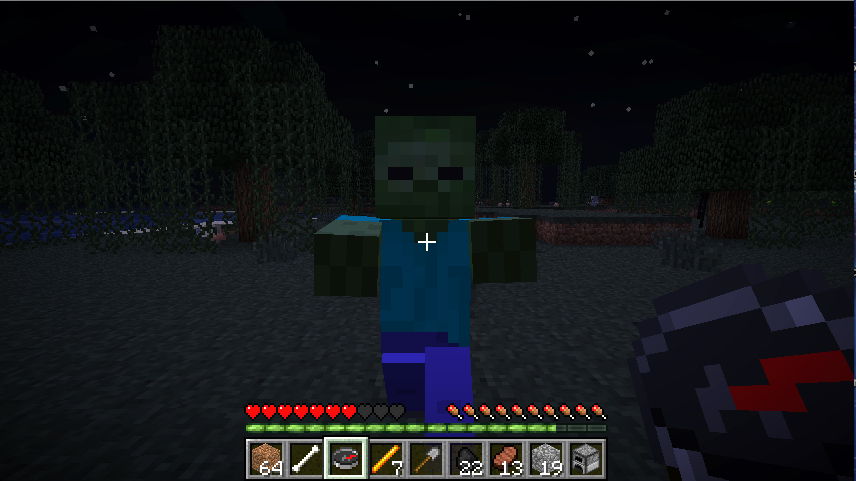
Zombie attack
Minecraft took this further. There are no points in Minecraft: just mining and building. The game places the player in a large procedurally generated world. Although deliberately blocky in design, the world is a mix of environments, including oceans, lakes and rivers, mountains and plains, and deserts and icy tundras. Populating this world is an unusual mix of creatures, from the mundane (pigs, cows and squid) to the violent (zombies, giant spiders and creepers). The more typical animals provide food and resources – from cows you can get beef, milk and leather; squid provide ink; sheep give wool; and chickens provide eggs, meat and feathers. The more aggressive inhabitants can also provide resources, but they are predominantly there to make your work a tad harder. (On the plus side, zombies and skeletons burn in sunlight, so they only present a threat at night or when you are in darkness, and spiders are non-aggressive during the day – although creepers, who explode when they get too close, are a constant threat). Along with the fauna is the flora, which includes grass, trees, flowers, mushrooms, bamboo, cacti and watermelons. These also provide much needed food and resources. But the point of the game isn’t the flora and fauna. They help to create a varied world, but the threats are easily overcome and the resources they provide are simple enough to come by. The really valuable stuff comes from the “mine” in Minecraft. Digging and exploring caves underground provides a wealth of useful ores, from rock and coal through to diamond and obsidian. By mining the world players are able to get the resources they need to build and survive.
This, of course, is where the “craft” comes into play. These resources can be used as they stand (cobblestone floors, wooden walls), or crafted into new things. For example, combine eight blocks of cobblestone in the correct fashion, and you’ve got a furnace. Toss in some iron ore and coal, and you have iron ingots. Take three iron ingots and add two sticks and you have an iron pickaxe: and with an iron pickaxe you can mine diamond, and with diamond you can make a diamond pickaxe. The diamond pickaxe can be used to mine obsidian, which in turn has some particular uses. The more you dig and explore, the more raw materials you get, and the greater the opportunities you have to combine them into something interesting. From chests and beds, through to castles suspended in the air, powered mine carts running along iron tracks, and virtual circuitry – including logic circuits to build computers and music sequencers within the game. When complete, you can share your designs through videos, by building them on multiplayer servers, or just through screenshots and shared save files.
For a while I foolishly found the success of the game curious – why, I wondered, would people be so devoted to a game that has no goal? It seems that I’m an idiot. I spent my younger years dedicated to Lego, and, like Minecraft, that has also no goal beyond the fun of creating. Thinking about it, there is nothing new or unusual about playing building games. It is simply that I forgot, somewhere along the line, that I can have fun without high resolution graphics and complex targeted gameplay. Fortunately Nothch didn’t forget. And fortunately, my children have discovered it as well.
A village from Minecraft 1.9
That said, Minecraft is a wonderful sandbox, but it has never been perfect, and I think it is reasonable to question whether or not the direction it is heading in is a wise one. Minecraft has been developed using an iterative model. Every so often Notch and his team would release a new version of the game, from the early alpha releases, through the on going beta versions, and more recently they started dropping buggy “pre-release betas” onto the market. Each version contains new features and modified functionality: for example, 1.8 beta introduced ravines, villages and strongholds, whilst the 1.9 pre-releases populated the village and introduced enchantments. To a large extent this has been working, but it relies heavily on the goodwill of the consumers (which, I should say, has been in abundance), and I fear that the increasing complexity may loose the enjoyable simplicity seen in the earlier versions. That second fear is something I see echoed in my son – he loves the game, and when he isn’t playing it he’s looking online to find out what is happening with the new releases, reading the Minecraft wiki, and watching every video he can get his hands on. Yet with each new version he expresses reservations, concerned that it won’t be as good as the old version was. So far that hasn’t happened, but it is an interesting aspect of the development model employed for the game.
It is also worth noting that the game has a rather idiosyncratic view of physics (and in particular gravity), but I suppose that can be seen as a feture as much as a a bug.
At any rate, I highly recommend Minecraft, and getting involved during the beta means that you will can get a copy a bit cheaper than when it is officially released. It is cross platform, relatively cheap, and it is genuinely enjoyable to play a game about building, exploring and avoiding zombies.




 The Adelaide Fan Review
You must be logged in to post a comment.