
Kim Stanley Robinson and his near-futures
As well as being a renowned author and scientist, Stan Robinson is one of the nicest people in science fiction.
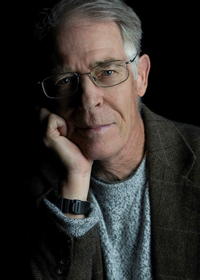
“Kim Stanley Robinson (born March 23, 1952) is an American science fiction writer best known for his Mars trilogy. Many of his novels and stories have ecological, cultural, and political themes and feature scientists as heroes. Robinson has won numerous awards, including the Hugo Award for Best Novel, the Nebula Award for Best Novel and the World Fantasy Award. The Atlantic has called Robinson’s work “the gold standard of realistic, and highly literary, science-fiction writing.” According to an article in The New Yorker, Robinson is “generally acknowledged as one of the greatest living science-fiction writers.” [Wikipedia]


💥 💥 💥
Prof Milner!
“Andrew Milner (born 9 September 1950) is Professor Emeritus of English and Comparative Literature at Monash University. From 2014 until 2019 he was also Honorary Professor of English and Comparative Literary Studies at the University of Warwick. In 2013 he was Ludwig Hirschfeld Mack Visiting Professor of Australian Studies at the Institut für Englische Philologie, Freie Universität Berlin.

“Locating Science Fiction is arguably Milner’s most important, potentially paradigm-shifting, book. Academic literary criticism had tended to locate science fiction primarily in relation to the older genre of utopia; fan criticism primarily in relation to fantasy and science fiction in other media, especially film and television; popular fiction studies primarily in relation to such contemporary genres as the romance novel and the thriller. Milner’s book relocates science fiction in relation not only to these other genres and media, but also to the historical and geographic contexts of its emergence and development.
“Locating Science Fiction sought to move science fiction theory and criticism away from the prescriptively abstract dialectics of cognition and estrangement associated with Fredric Jameson and Darko Suvin, and towards an empirically grounded understanding of what is actually a messy amalgam of texts, practices and artefacts. Inspired by Williams, Bourdieu and Franco Moretti’s application of world systems theory to literary studies, it drew on the disciplinary competences of comparative literature, cultural studies, critical theory and sociology to produce a powerfully distinctive mode of analysis, engagement and argument. The concluding chapter is preoccupied with environmentalist thematics occasioned by Milner’s growing interest in Green politics.” [Wikipedia]
You are invited to a Nova Mob meeting gathered around a big TV screen at the Kensington Town Hall, for Dr Andrew Milner by Zoom:
Wednesday 4 June 2025 8.00pm – 9.00 Melbourne (7:30-8:30 Adelaide) (formal close), first floor Creative Hub.
Lift access. Stairs access. Both available.
Zoom meeting closes about 9.20pm or so.
Kensington Town Hall. 30 – 34 Bellair St
Kensington Melbourne VIC 3031
By Zoom – simulcast
You are invited to a scheduled Zoom meeting. Please join us on-line!
Wednesday 4 June 2025
8.00pm – 9.30 pm Canberra, Melbourne, Sydney time
7.30pm – 9.00pm Adelaide time
Join Zoom Meeting
https://us02web.zoom.us/j/4177583193?pwd=VjdPL1BhSTBNclN2YnRsejN3Y1hlUT09
Passcode: nova
Meeting ID: 417 758 3193


 The Adelaide Fan Review
You must be logged in to post a comment.