October 8th MiniCon!

10am — 4pm, Saturday October 8th
at the SA Writers’ Centre, Second Floor, 187 Rundle St
    $10/5

The third in a series of small conventions, this one will look at various aspects of Joss Whedon’s creations.

Programme:

  • Registration from 9:30am
  • 10am Welcome & Introductions
  • 10:30am  the Ethics of Dollhouse
  • 11:15am   Buffy season 8
  • 12 noon     Spike or Angel?
  •  12:30ish Lunch/Quizzez/Film votes
  •  1:20 Website Launch
  • 1:30 Podcasting and other Audio
  • 2:30 Galactic Empires: Firefly, Star Trek or Star Wars
  • 3:15 Best SF films ever
  • 3:45 Roundup & Close

We’ll look at Podcasting with special guests Gerri and Eugenia from Women talk Sci Fi, and Peter from 80 page Giant.

We’ll select the best SF/fantasy film ever from 100s of candidates, launch a new website and consider what’s new and exciting in the world of speculative fiction.

Interested? Then come along on Saturday!
Registration from 9:30am.

Jim Butcher’s Ghost Story

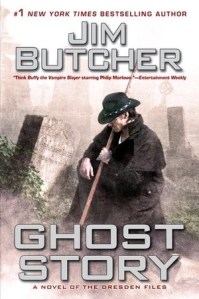
US cover of Ghost Story by Jim ButcherThe Dresden Files was always a series that was going to appeal – a hard-boiled, wisecracking detective in an urban fantasy setting was something that I could be guaranteed to like. And, as a concept, I most certainly have enjoyed it: Butcher has done a fine job of world building, and I’ve greatly enjoyed the place he has created.

For those who haven’t caught the series, the Dresden Files follows Harry Dresden, a wizard and private investigator working out of Chicago. Dresden has been described as a magical thug – he doesn’t have the finesse to pull off many complex magical spells, but he has the raw power to hit hard. Thus the series tends to follow a basic framework: Harry discovers something is wrong, Harry finds the cause, and Harry burns the perpetrator (be it a vampire, evil magician, werewolf or other) to death in massive amounts of magical fire (or some similarly, over-the-top, magical spell). Harry isn’t subtle. On the way Harry tends to get caught up in a mess of problems, typical arriving at the story’s climax half dead from the various battles he’s been through on the way. It feels a bit like a fantasy version of Die Hard, where Harry survives more by stubbornness and an unwillingness to die than anything else.

This, of course, changed in the aptly named Changes, the 12th novel in the series. At the end of Changes Harry was dead, creating a bit of a problem, although the alert reader will presume that this isn’t a state that is likely to limit Harry: Butcher had already revealed that there would be at least 20 books in the series, so his continued appearance was assured. Thus Ghost Story continues to follow Harry’s adventures, only now as a corporally-challenged magical private investigator.

In the latest novel, Harry returns to Chicago as a ghost under instructions to find his murderer, knowing that if he fails at least two of his friends will suffer. As a ghost his abilities are severely curtailed: he can only been seen by a select few individuals, he is under constant threat by his fellow undead, and he can’t directly interact with the physical world.  Therefore in this novel he is following a new set of challenges, having to stop and think rather than just throw fire and burn everything that stands in his path. The opposition has changed as well. In Changes, Harry was fighting against the vampires of the Red Court (the world of Harry Dresden involves four distinct types of vampires, with Red Court being a variation of the traditional blood-sucking, sun-avoiding monsters). This is no longer an issue. The new villains major are The Fomor,  but they play a mostly off-stage role in Ghost Story. Instead the focus is the Grey Ghost, a seemingly new character that is interested in Mortimer Lindquist, an ectomancer. On Harry’s side are many of the same characters from the earlier novels: his apprentice, Molly, ex-cop Karrin Murphy, coroner Waldo Butters, the friendly werewolves, and Bob (the skull). What makes it more interesting is that they don’t trust Harry, and tend to marginalise his input – an interesting change from the preceding novels, although the focus remains on the somewhat-ignored Harry throughout the book.

So now for the negatives. I stand by my earlier comment that I love the world building in the novels, and I’ll add to that a love of the plotting and the witty- one-liners. What I don’t love is the dialog and characterisation – if nothing else, there are only so many times you can read “hell’s bells” on a page before it becomes more than just a tad distracting, and other than Harry and Bob, most of the characterisation tends to be poor. Butcher did spend some time on the secondary characters here, but it still felt a bit like a wasted opportunity. Generally speaking, Butcher’s writing is serviceable, (even though his plotting and world building are very strong), and while this is sufficient for a while (in much the same way that you can ignore the script in a big-budget Hollywood special effects extravaganza, and for much the same reason), over thirteen novels it tends to make itself felt.

Other than those concerns, I have to admit that, although I love SF references and in-jokes, I’ve now discovered that I have my limits. Unfortunately, we ran into that limit before the end of the novel, so the climatic scene fell more than a little flat. It was also disappointing that some of the themes that were alluded to – such as the nature of free will, the soul, and the role of memories in identity – were referred to but barely explored. As part of this, it was, in a sense, disappointing how the solution to many of Harry’s problems was the same as it always is: the situation Harry was in was, unsurprisingly, very different from those he had been placed in before, yet his response was, ultimately, what we’re used to. It seemed a bit like another lost opportunity, a chance to explore alternative directions that don’t involve massive amounts of killing fire. But, I guess, there’s something to be said for special effects, even if they’re literary instead of on the screen.

But there was one major plus that has restored my enjoyment of the series. The earlier Dresden Files novels had delightfully convoluted plots: Harry would be chasing several different leads on several different problems, which may or may not come together at the end. Thus the last stages of the novels saw Harry running from place-to-place, winding up plot threads has he worked his way to the ultimate showdown at the end. But this had been reduced in the more recent books, with more narrowly focused stories that lost some of that Die Hard feeling that I had enjoyed so much before. Ghost Story brings it back: by the end of the novel Harry has multiple threads to follow, some of which are related and some which aren’t, and all of which he has to settle within a few hours. Thus we fully return to the model that I had enjoyed when I first encountered the books.

Overall, I purchased this book with some trepidation, but was rewarded with what was both an enjoyable read and a nice segue into the new direction for the series. I’d have loved to have seen more of the characters that weren’t Harry, and perhaps less of the SF references, backstory and painful self-recrimination, but it provided some much-needed backstory, was pleasantly convoluted, and had the action one would expect from a Dresden novel. All of which combined to make for a good return for the series, and one which has reinvigorated my interest.

D M Cornish Interview

David Cornish studied illustration at the University of South Australia, where in 1993 he began to compile a series of notebooks: over the next ten years he filled 23 journals with his pictures, definitions, ideas and histories of his world, the “Half-Continent”. It wasn’t until 2003 that a chance encounter with a children’s publisher gave him an opportunity to develop these ideas further. Learning of his journals, she urged him to write a story from his world. From this grew the Monster Blood Tattoo series.

Ewart Shaw talked to him about his work.

Listen: Download  (MP3,   5.1MB)

Liberator

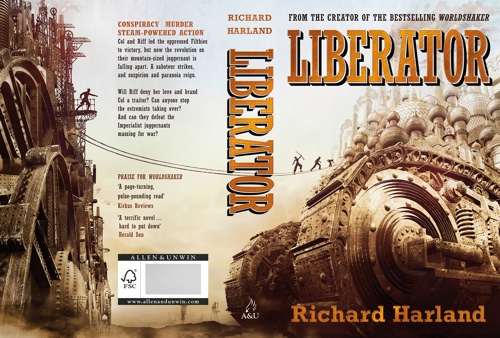
Richard Harland was at Swancon over Easter, with copies of his new book, Liberator, the sequel to WorldShaker.

We persuaded him to read an excerpt from the Novel.

It’s a YA novel, and a cracking good read. Politics, romance, betrayal and plenty of page-turning action. I whipped through my copy in a day, enjoying it all the while. Who would have thought that corsets would trigger counter-revolutionaries?

Metropolis 1927 restored!

Two extraordinary events combined to find me in the Piccadilly cinema in North Adelaide, watching a silent film from 1927.
The unexpected discovery of several dusty reels in a small museum in Buenos Aires in 2008 provided us with most of the footage cut from the original version of Fritz Lang’s Metropolis. An expert team of film archivists has been working at the Friedrich-Wilhelm-Murnau-Stiftung in Germany to painstakingly reconstruct and restore the film.
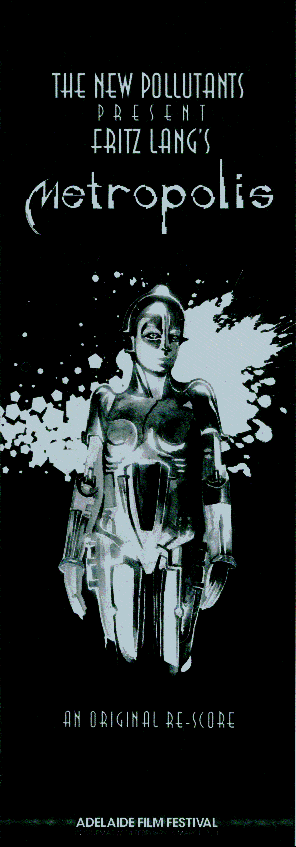
Two years ago, the Adelaide Film Event commissioned the New Pollutants to create a new score for Metropolis; this year, they extended the score to cover the additional 23 minutes of the restored, definitive, version.
Having seen, and marvelled at, fragments of the film in the past, I couldn’t resist the chance to view the full version — with the new score, performed live, as part of this year’s film event.

The soundtrack was sublime: announcements over the speakers in the factory scenes made me forget that this was a silent movie! The restored scenes made for a more interesting story, and the restored film was astonishing.
Ah, those biplanes flying between buildings, under walkways! Rotwang and his robot Maria, and her debauched, mesmeric dancing. Angular, debauched, seductive and yet somehow wrong.
Plots! Revolution! Super science! Madness, and Redemption. Even the classic rooftop chase after the villain.
It’s splendid that the film has been restored: if you get the chance to see it, do so. You won’t regret it.

Fiasco

Publisher: Bully Pulpit Games

SKU: BPG005
Price: US$25 (Print)/US$12 (PDF)
Rating: Great 

One of the more popular sub-genres of role-playing games of recent days is the story-telling game. In this genre, whilst you are usually playing the role of a character, the objective is not to have adventures with the character in order to benefit the character, but rather to collaboratively tell an interesting story with the character. The investment of the player being in the story, not the character. And if the best stories end up having the character meet a grisly end, then this is something that is more likely to happen with a story-telling game than a traditional tabletop (or computer) role-playing game.

This is particularly true in the case of Fiasco, by Bully Pulpit Games. This storytelling game is inspired by those cinematic tales of small-time capers that go disasterously wrong for all involved. We are talking Fargo, Burn After Reading, Blood Simple, A Fish Called Wanda, A Simple Plan, Oh Brother, Where Art Thou, Lock Stock and Two Smoking Barrels and Office Space. Basically anything with a cast of ordinary people with powerful ambitions and poor impulse control. Where “it seemed like a good idea at the time” is the watch-phrase, and things start going rapidly out of control. Where poorly executed plans soon collapse into a glorious heap of jealousy, murder, and recrimination. Where lives and reputations will be lost, painful wisdom gained, and if a character is really lucky (or truly vile or innocent), they may just end up back where they were to begin with.

The first thing to do when playing Fiasco is to gather three to five people in a circle. Like many story-telling games, this is a collaborative activity, and so there is no gamemaster. Instead the rules provide the formal method of interaction that govens the interactions of the players.

The players must then decide what sort of setting they want to use. In Fiasco these settings are called Playsets, and they contain the detailed information to set up play. There are several Playsets to be found in the rules, and a new one each month is put on the Bully Pulpit Games website. Additionally it has become quite popular for Famous Game Designers™ to write and publish their own Playsets. Here are some of the Playsets that are available:

Once they have decided on a setting, they must generate the relationships that exists between their characters. They each take two black dice and two white dice and roll them in the centre of the table, creating a pool of dice. They then each take turns selecting a die from the pool, and converting this is converted into a specific Relationship, Need, Location, or Object by consulting the Playset. Each player will have a Relationship with an adjacent player, and there should be at least one Need, Location, and Object.

For example, a player using the Objective Zebra Playset might decide to take a black 6 to detail a Relationship between two characters. This translates to “Family,” and so he writes down “Relationship: Family” and places the index card between two players, indicating that the two players are family of some kind. During a later turn a player (either another or the same), takes a white 4, looks up “Family,” and discovers that the actual Relationship is that they are “Blood Brothers,” so the index card is amended to read “Relationship: Family – Blood Brothers.” A player then decides to attach a Need to this Relationship by taking a black 3 and looking up the result for this Need in the Playset, discovering that it is a “Need: To hide that…” A later white 1 added to the index card indicates that it is a “Need: To hide that you didn’t exactly follow orders concerning Objective Zebra.” So you have two blood brothers with a need to hide the fact that they didn’t exactly follow orders concerning their mission. Of course, each of these characters will be further defined by the Relationship and Detail on the other side of their player.

The players now have to interpret how these relationships define their characters, and in return, how their characters define the Relationships and Details. Remember that this is a collaborative activity, so it’s important to share your thoughts. Once this is done they can begin with the actual game play.

The dice are returned to the centre of the table. They will be used for scoring. At the conclusion of your turn you will be given a die from this pool by the other players, which will reflect the outcome of your story. A black die indicates negative consequences, whilst a white die indicates positive consequences. During the first Act you must give this die to another player. During the second Act you get to keep it. It’s better to get all white or all black dice, so naturally people will try to give you dice you don’t already have. The trick is to tell a story such that they don’t want to accept the consequences of giving you the wrong colour die.

During your turn, you get the opportunity to either Establish a scene or Resolve a scene. If you Establish a scene, you get to set the scene up, invoking whatever relationships and details you think are important. Based on your performance, the other players will give you a die. If you Resolve a scene, the other players will generate a scene for you, and you will choose a die. In either case the colour of the die will affect how the scene actually plays out, and whether the outcome of the scene will be a success or a failure.

One great thing about this game is that character death doesn’t matter. In fact it can be weirdly liberating, as it allows you to tell the rest of the story in flashback. Although it is considered impolite to kill anyone before Act Two.

Act One is basically used for setting up the inevitable fiasco. Between the Acts, further complications will emerge; this is known as The Twist. Then play proceeds to Act Two, where the wheels generally come off and everything falls apart. Then comes The Aftermath, where your character’s actual story is resolved.

The Aftermath is resolved by rolling the dice that you were given in Act One and Two, and generating a white total and a black total. Subtract the lower from the higher. That’s your overall result, with the higher the better. This is why you generally want dice of a single colour. Finally, for each die you have, you can make a single short statement about what happens to you. So characters without many dice soon disappear from the narrative (inevitably down-trodden and probably dead).

Now this is only the basics of the game. The actual rules discuss all of this in detail and provide examples of how it all fits together, and explains in greater detail the interaction that occurs. They are something you really want to understand before you attempt to play the game, no matter how simple it sounds. In particular, the trick of trying to tell the story in such a manner as to ensure that the other players give you the die you want is something that takes a little practice. It also relies on the players being able to take the set-up and run with it, and purposefully engage with the other characters.

Ian