‘‘One of my best friends is a direct male-line descendent of Genghis Khan. She has the documentation to prove it. I got fascinated by the way Genghis Khan is portrayed, as opposed to the way Alexander the Great is portrayed. They both won! In Mongolia, Genghis Khan is a culture hero, still to this day. The stuff that he accomplished, on a technological level and on a social level, is astounding. The Mongol Empire had bankruptcy laws. The third time you declared bankruptcy, they executed you, but that might not be a bad thing for us – it might solve some of our Wall Street problems.”
— Elizabeth Bear, interview 2012, Locus
I think that the accepted definitions of what marks a book as a certain genre are too broad to be useful. SF does not necessarily involve ray-guns and time travel (although it might), fantasy does not have to feature goblins and spells (although it might) and Westerns do not particularly have to feature horses, gun-play and stetsons (although they might).
In the Jasper view of genre, Sirens of Titanis not SF but philosophy, anything by Terry Pratchett is not fantasy but satire, and True Grit is not a Western but a “coming of age/epic revenge/historical fiction”.
This year, we thought we’d challenge ourselves to pick the winner of the 2019 Hugo for best short story. So to prepare for the discussion, please read the following stories in time for the meeting, and be prepared to debate which one is “best”!
Chris Priest, in his awesome capacity as agent for the Sladek estate, is very pleased with the early proof copy he’s seen; I hope to have a big pile of trade paperbacks in good time for Easter. Paperbacks and ebooks will also be available for order online, from Lulu.com and Ansible Editions respectively.
Two pieces of interesting info: opposite Frances McDormand’s God will be a Satan voiced by none other than Benedict Cumberbatch; and the series premiere will be may 21st!
Although Vonnegut often resisted his inclusion in the science-fiction club, he did consider himself part of the last generation of great American novelists (generally labeled “postmodernists”), bound together by this tendency to write about unreal and incomprehensible ideas in unusual styles. He knew there would be more novelists, of course, and some of them great, but he feared that never again would so many untested young authors hone their craft together, as a community. Part of this was rooted in economic changes to the publishing industry, but there was another threat to the novelist’s place in society: censorship. In a 1979 letter to Soviet writer Felix Kuznetzov, Vonnegut laments that writers everywhere “are routinely attacked by fellow citizens as being pornographers or corrupters of children and celebrators of violence and persons of no talent and so on. In my own case, such charges are brought against my works several times a year.”
Since its publication in March of 1969, Slaughterhouse-Five has been banned in several communities across the U.S., and challenged over 350 times for its sexual content, violence, obscenity, and “anti-religious” language. Perhaps most famously, 32 copies of the novel were burned in a Drake, ND school district in 1973. Later that year, Vonnegut wrote to Drake Public School Board President Charles McCarthy to express his anger and dismay at the school board’s actions, and to challenge the labeling of his work as “offensive.”
— Sarah Tolf, on tor.com “Kurt Vonnegut and the Science Fiction Writers’ Lodge”
DUST is the first multi-platform destination for binge watchable sci-fi. We feature science fiction short films and other content from emerging filmmakers with stunning visual effects, captivating plots and complex character explorations. Robots, aliens, space exploration, technology, and human experience are all a part of DUST. New uploads every week with DUST exclusive premieres and original series.
High Life is a 2018 English-language science fiction film written and directed by French director Claire Denis with Robert Pattinson and Juliette Binoche in the leads. It is Denis’ first film in English, and was co-written by her long-time collaborator Jean-Pol Fargeau and Geoff Cox.
The film focuses on a group of criminals who are tricked into believing they will be freed if they participate in a mission to travel on a spaceship towards a black hole to find an alternate energy source while being sexually experimented on by the scientists on board.
High Life will screen several times during the Alliance Française French Film Festival (Mar 30, Apr 2, Apr 7, Apr 17th at the Palace Nova Eastend; 25 mar, 14 Apr at the Palace Nova Prospect).
Kate Treloar suggests we look at the Broken Earth Trilogy by N K Jemisin, and will talk about the first novel, The Fifth Season, at the meeting on April 3rd, 2019.
As usual, we meet at Kappys, 22 Compton St, Adelaide. 6:45 for a 7pm start.


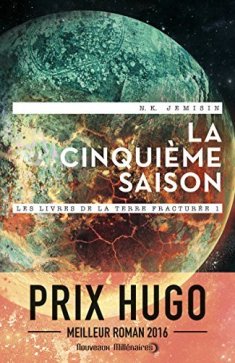 Kate Treloar suggests we look at the Broken Earth Trilogy by N K Jemisin, and will talk about the first novel, The Fifth Season, at the meeting on April 3rd, 2019.
 The Adelaide Fan Review
You must be logged in to post a comment.