At last: the collection of Peter Nicholls’s science fiction essays and reviews that he first planned way back in the 1970s, and reconsidered late in life but never completed. All proceeds from sales go to support the Encyclopedia of Science Fiction, of which he was the founding editor in 1979 – writing much of the text himself – and co-editor for the second (1993) and third (2011 online) editions.
Genre Fiction: The Roaring Years comprises 60 witty and insightful pieces by Peter Nicholls, including a long, previously unpublished speech and the new introduction he wrote in 2012. His long-time Encyclopedia colleague John Clute contributes a foreword. The collection was compiled by David Langford with the support and assistance of Peter’s family, and runs to more than 220,000 words of vintage Nicholls. epub available from https://ae.ansible.uk/?t=roaring
Our guest speaker this month is Gillian Polack, who will join us via zoom.
Talking about food in fantasy novels. Gillian will talk about some of the different roles food can play in fantasy novels, focusing on recent (ish) Australian fantasy novels. This will include how food can help build narrative and reinforce character, how writers world build using food, plus the role genre and the writer’s personal background play in how food and foodways are incorporated. Stew will not be forgotten.
Join Zoom Meeting 6:30pm Wednesday, October 26th Adelaide 7pm Melbourne, Canberra, Sydney 9am London /11am Helsinki
September 7 – Jane Routley & the Nova Mob discussion “My Favourite Utopia”. In person and Zoom. October 5 – to be finalised. Zoom only. November 2 – Ian Mond “Mondiale – best books of 2022”. In person and Zoom. December 7 – Chris Flynn “Here Be Leviathans”. In person and Zoom. December 14 – end of year celebration event. In person only. 1st February 2023 – First meeting of the new year. Topic to be finalised.
💥 💥 💥
Jane Routley – “My Favourite Utopia”
September 7 – Jane Routley & Mob “My Favourite Utopia”.
In person and remotely by Zoom.
Utopias are perfect places, which is a problem for story-tellers because compelling stories require conflict and the ideal utopia is universally a happy place. It follows that Utopian fiction is about the flies in the ointment, not the ointment itself. There is an exception, it’s of limited appeal, where recipes of the ointment are provided by way of tour guides of the utopia and not much happens by way of story.
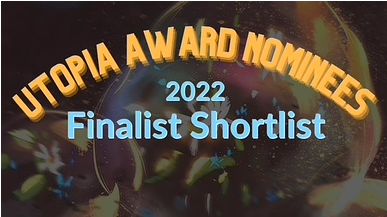
Jane’s been reading the 2022 Utopia Award nominees and it’s put the spotlight on the problem of Utopia as “ointment, would you like flies with that?”. According to some academics Utopian fiction is one of sf’s largest subgenres, or is a separate genre. If there’s so much of it, surely there should be some really good stories?
Jane will discuss this year’s Utopia Award nominees.
Then it’s open discussion on these questions:
1.one’s favourite utopia – in which utopia would you want to live?
2.recommend a novel or story for someone new to utopian fiction
3.best film or TV utopia
Of course, a utopia doesn’t have to be labelled as such to be perceived as being a utopia by the reader or by its inhabitants. Is the near-future of Star Trek a utopia? To many viewers, it is.
Discussion will include Zoom participants. The list of stories from the night will be published.
Each meeting we get a little better at Zoom, and encounter new twists to the conundrum of operating a seamless video conference in combination with the face to face meeting. We see this process of continuous improvement as never-ending, indeed interminable.
Screening at the Mercury, Tuesday, Aug 30th Directors: Robert B. Weide & Don Argott Stars: Linda Bates, Jerome Klinkowitz, Sidney Offit Recounting the extraordinary life of author Kurt Vonnegut, and the 25-year friendship with the filmmaker who set out to document it. A gorgeously rendered, unexpectedly moving appraisal of the life and craft of one of the best-loved literary voices of the late 20th century.
If you think about film adaptations of SF stories, you might well notice the large number of films (and TV shows) based on the works of Philip K Dick.
This month, we’re inviting you to read one (or more) of his stories, then watch a film (or TV show) based on the story. Was it an interesting film? How faithful was it to the story? Did they make any major changes? What is your favourite PK Dick film? How faithful was it?
Films based on PK Dick stories
Title (year of publication)
Title (Year, Director)
Second Variety (1953)
Screamers (1995, Christian Duguay) Screamers: the Hunting (2009, Sheldon Wilson)
Paycheck (1953)
Paycheck (2003, John Woo)
Imposter (1953)
Imposter (2002, Gary Fleder)
Adjustment Team (1954)
The Adjustment Bureau (2011, George Nolfi)
The Golden Man (1954)
Next (2007, Lee Tamahori)
The Crystal Crypt (1954)
The Crystal Crypt (2013, Shahab Zargari)
The Minority Report (1956)
Minority Report (2002, Steven Speilberg)
We Can Remember It For You Wholesale (1966)
Total Recall (1990, Paul Verhoeven) Total Recall (2012, Len Wiseman)
The Father Thing, Philip K. Dick’s Electric Dreams
The Impossible Planet (1955)
David Farr
The Impossible Planet, Philip K. Dick’s Electric Dreams
Human Is (1955)
Francesca Gregorini
Human Is, Philip K. Dick’s Electric Dreams
Autofac (1955)
Peter Horton
Autofac, Philip K. Dick’s Electric Dreams
Foster, You’re Dead! (1955)
Alan Taylor
Safe and Sound, Philip K. Dick’s Electric Dreams
Minority Report
Minority Report (2015)
The Man In The High Castle
The Man In The High Castle TV series (2015)
Total Recall
Total Recall 2070 (1999)
They have collected the stories on which the TV series Philip K Dick’s Electric Dreams is based in the book Electric Dreams. Alternatively, the stories can be found in the five volume collected short stories of PK Dick (see https://en.wikipedia.org/wiki/The_Collected_Stories_of_Philip_K._Dick for a listing of stories by volume)
Doors open at Kappys in Compton St at 6:15, meeting starts at 6:30 Adelaide time. It will be a joint live/zoom meeting, barring a nasty outbreak of a new covid variety.
On Wednesday, we discussed the Hugo nominees for Short Story and Novelette.
We agreed on “Mr. Death” by Alix E. Harrow (Apex Magazine, Feb 2021) as the best short story, with a close second in “Unknown Number” by Blue Neustifter. “Where Oaken Hearts Do Gather” by Sarah Pinsker was also interesting.
Dragons are cool. Giant scaly (or feathered) winged beasties, hovering in the skies or lurking in deep, dark caverns. Some are bearers of luck, some wreak havoc with a belly filled with fire. And many seem to be really into sitting around on a giant gold pile (though why is murky—are they hoping to bring back the gold standard?). So, yeah, dragons in fantasy literature are the coolest creatures out there (yes, I know, they can also be extremely hot), and their presence lends a grandeur and majesty to any story. Depending on the story, they may be metaphor for the human condition, they may be aliens we live among, or they may be an existential threat unlike any you’ve ever encountered before.
…Except that not all dragons are like that. In fact, some of the most memorable creatures in fiction stick with us because they are the exact opposite of all of those things we’ve come to expect.





 The Adelaide Fan Review
You must be logged in to post a comment.