Earth size exoplanets!

trappistfrom io9:

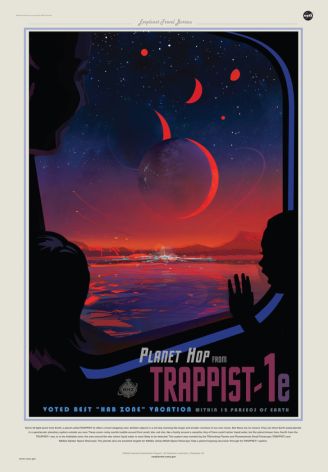
On Wednesday, Earthlings were shocked—and certainly relieved—to finally get a push notification about planetary discovery, not political corruption. News broke that an international team of scientists had spied seven Earth-sized planets orbiting the nearby star TRAPPIST-1. Three of those planets are located in the habitable zone, where liquid water might form. NASA, the unofficial planetary hype train conductor, along with researchers behind the discovery, are doing everything in their power to drum up public excitement—including building a mythology for TRAPPIST-1 that blends science fact and fiction.

This week, planetary scientists launched a website for the star system that’s full of gorgeous infographics with data on the seven TRAPPIST planets. NASA has also added TRAPPIST-1 to its “Exoplanet Travel Bureau,” where it imagines what vacationing in the star system might be like.

— from io9

No Critical Mass for March

With the Fringe, the car race, and the unavailability of speakers, we’ve decided to cancel the March 1st meeting. We’ll try and make it up to you with a special extra meeting later in the year.

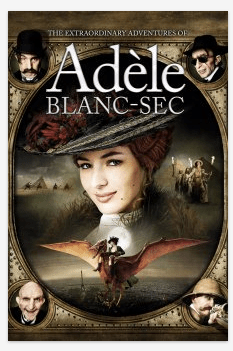
Our apologies if you were looking forward to it: go watch The Incredible Adventures of Adele Blanc-Sec if you need your SF fix!


Fannish history

iOTA is a little efanzine put together by Leigh Edmonds for the singular purpose of keeping informed the fans who are interested the progress of his project to write a history of Australian sf fandom with a focus on the period from 1956 to 1975, and sundry offences.

Leigh’s kindly sent me electronic copies, and we chatted last weekend about how it’s progressing. As a professional historian, he’s talking to key fans active pre-1975 and sharing his interim results in iOTA. You can download copies at efanzines.

As he notes in the first issue:

The first reason for researching and writing as history of Australian fandom is; why not? From an academic point of view, I think that a history of what science fiction fans did might be considered a vital adjunct to the current study of science fiction, due to the very close relationship between sf and fandom over the generations. I’m also keen to do this because most of my recent history projects have been about large organizations employing thousands of people, and I’m looking forward to a project in which it is possible to get closer to people and their daily lives. Perhaps most important, this project will tell a story about what fans did and what their lives were like. We had fun, didn’t we? That should be worth celebrating.

A french, female Indiana Jones

Perhaps better described as a cross between Indiana and Lois Lane, our intrepid reporter, Adèle deals with curious events in pre-war Paris (1911).

screen-shot-2017-02-26-at-4-06-41-pmThe wonderful SBS recently screened The Extraordinary Adventures Of Adèle Blanc-Sec, the glorious fantasy based on a french graphic novel series. If you haven’t seen it yet (for some reason it didn’t get general cinema release, despite its well-known director), you can view it via SBS’ OnDemand service on their website. Worth catching if only for the most violent tennis match you’ll ever see on screen!

Luc Besson directs this visually impressive adaptation of the graphic novel following an independent-minded writer who becomes embroiled in a mystery involving mummies, bad guys, and dinosaurs in pre World War I Paris. Desperate to cure her near catatonic sister, intrepid authoress Adèle Blanc-Sec braves ancient Egyptian tombs and modern Egyptian lowlife to locate a mummified doctor and get him back to Paris. Her hope is that oddball Professor Espérandieu will then use his unusual powers to bring the doctor back to life so he, in turn, can use his centuries-old skills on the unfortunate sister. In Paris however Espérandieu is already causing mayhem, having brought to life what was a safe museum egg but is now a very active pterodactyl.

Pullman on Brexit

While we’re talking about Philip Pullman, you might want to view his commentary from the Guardian, June 2016:

There is our country’s post-imperial reluctance to let go of the idea that we are a great nation, combined with our post-second-world-war delusion that we were still a great power. That was why we refused the chance to join the European Coal and Steel Community in 1951, and our infatuation with our own greatness was sufficiently undamaged by Suez in 1956 to make us refuse to join the EEC when that got going with the Treaty of Rome in 1958. If we’d committed ourselves to Europe early, with everyone else, we’d now have a much deeper understanding of our real relationship to the continent, namely that we belong there.

He also has some scathing things to say about Australian media moguls, the British Labour Party and the British Constitution. Worth a read.

Europe at Midnight

I still wasn’t sure whether England was in Europe or not; I had the impression that the English would have quite liked to be in Europe as long as they were running it, but weren’t particularly bothered otherwise
Dave Hutchinson, whose character was commenting on English attitudes in the middle book of his  Fractured Europe trilogy

Philip Pullman announces sequel

 Philip Pullman has announced that The Book of Dust, a new epic fantasy trilogy, which will stand alongside his bestselling series, His Dark Materials, will be published in October around the world.

Set to come out on 19 October, the as yet untitled first volume of The Book of Dust will be set in London and Oxford, with the action running parallel to the His Dark Materials trilogy.  […] Pullman’s brave and outspoken heroine Lyra Belacqua will return in the first two volumes. Featuring two periods of her life – as a baby and 20 years after His Dark Materials ended […]

Announcing the new books, the Oxford-based former teacher said he returned to the world of Lyra because he wanted to get to the bottom of “Dust”, the mysterious and troubling substance at the centre of the original books. “Little by little through that story the idea of what Dust was became clearer and clearer, but I always wanted to return to it and discover more,” Pullman said.

In a description that will resonate with the current political climate, he added that “at the centre of The Book of Dust is the struggle between a despotic and totalitarian organisation, which wants to stifle speculation and enquiry, and those who believe thought and speech should be free”.

— from The Guardian, 15 Feb

Fractured Europe

europeEurope in Autumn; Europe at Midnight; Europe in Winter

by Dave Hutchinson

[A review by David Grigg in The Fretful Porpentine #12]

The first book in this ‘Fractured Europe’ series was recently recommended to me by Carey Handfield, and I bought it as a ebook for a few dollars. Then I rapidly went out and bought the second. The third, maddeningly, wasn’t yet out, but I placed it on pre-order and it arrived a couple of weeks ago.

So I read these three books in a matter of a few weeks. And then I turned around and immediately read them all through again from cover to cover, and I’m glad I did—so much I had missed or not understood now became clear(er). But even now I’m not sure that I fully understand what has been going on, and I’m wondering if there will be a fourth or fifth book in the series which may reveal more. Talk about ‘a riddle, wrapped in a mystery, inside an enigma‘? (A not inappropriate quotation, as it turns out).

Where to start? Well, first we have to set the scene, which is the near-term future in Europe after the European Union has essentially broken up back into its individual nations. But the rot hasn’t stopped there, and there’s a wave of independent nations, principalities or ‘polities’ breaking off from those nations, as regional and ethnic loyalties come to the fore. This reaches an almost absurd degree, with in some cases a few blocks of some cities declaring their independence. The whole concept of the Schengen Treaty of doing away with borders in Europe is now a sad, half-forgotten joke. Borders and border controls are everywhere.

Even more interesting, a trans-continental railway line has been built from Spain through to Eastern Sibera. On its completion the company promptly declares the railway and the land immediately surrounding it to be sovereign territory, and that the Line is now an independent nation. The Lines stations are Consulates. One needs a visa to travel on the train, and to become a citizen to work for the Line. The author somehow makes this all seem perfectly rational.

We’re introduced to Rudi, the young Estonian-born chef at Restaurant Max in Krakow, in Poland. Through some shady connections of his boss Max, Rudi is eventually recruited into a shadowy organisation called Les Coureurs de Bois (“the runners of the woods”?). It’s kind of a courier operation, carrying mail and packages from one nation to another—something no longer easy, or even necessarily legal. It’s like a cross between a courier company, a smuggling ring, and an espionage outfit. Most governments heavily disapprove of it.

For most of the first book, were learning about Rudi and following him on the various Situations he’s placed in from time to time (while still mostly working as a chef). Some of these go well, a few go wrong, and eventually disastrously wrong. Something very strange is going on, and Rudi finds that he is being hunted and that his life is in danger. All of this (other than the slightly futuristic setting) has the engaging fascination of a spy thriller, or perhaps one of the Jason Bourne movies. Apart from the occasional use of advanced technology like ‘stealth suits’, this all seems barely like science fiction at all.

I can’t describe too much more without spoilers. Suffice it to say that about 80% through the first book, Rudi has finally tracked down what a dying former Coureur tells him is ‘the proof’. It’s in the deciphering of this proof that Rudi discovers a secret which does plunge us into real science fiction territory.

I enjoyed the second book even more than the first, as we encounter the first person narrative of ‘Rupert’ who lives in a vast (really vast) university campus run as a totalitarian regime, which has just undergone a bloody revolution. How this ties in with what Rudi has discovered in the first book takes quite a while to emerge.

It was really worthwhile re-reading the books. So much of what is going on in earlier parts of the narrative is explained by what comes later that you are almost compelled to go back and read those earlier passages again. It’s a tribute to how good the writing is that all three books were just as enjoyable to read again so soon.

Puzzling, challenging, but very good. Written, by someone who seems to know Eastern Europe (and the restaurant trade) very well; very clever plotting; really original concepts; great characterisation. I loved them and look forward to reading more from this author.

SF in SF

Gun, With Occasional Music by Jonathan Lethem

Gun, with Occasional Music by Jonathan Lethem

Lethem’s now-classic update on San Francisco noir features a hardboiled, highly sarcastic detective named Metcalf, a murder, and a conspiracy that might just go all the way to the top. But this version of San Francisco also features uplifted animals (like the Mafiosi kangaroo Metcalf keeps running into), mature babies with their own subculture, and quantifiable karma that people use as social credit—when you use up all your karma, you have to go to cryo-sleep until you pay it off. Against this background, Metcalf attempts to solve the murder of Maynard Stanhunt, despite the fact that no one seems to want him to solve it. And, oh yeah, in this universe asking questions is socially unacceptable, and detectives are utter pariahs. Did I mention that guns literally play disturbing music when you draw them? Gun, With Occasional Music was nominated for a Nebula Award in 1994.

— from  Leave Your Heart in San Francisco with 10 Sci-Fi and Fantasy Stories! by Leah Schnelbach on Tor.com.
Check out the other 9 on their website!

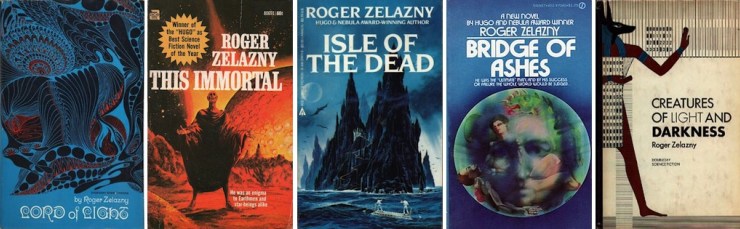
Lord of Light

You always get asked, “When did you know you wanted to be a writer?” And, of course, there’s no answer, or a thousand answers that are all equally valid. But I usually say, “In high school, when I read Zelazny’s Lord of Light.”
Stephen Brust, witing on tor.com “Five Roger Zelazny Books that Changed My Life by Being Awesome”
zelazny-5books