“Deadly Earnest” was a late-night horror host that appeared on Australian commercial television stations between the years 1959 and 1978.
Played by five different actors in each of the mainland States over the course of this nineteen-year period, the host was used to introduce horror films and brought an element of comedy to them during a time when Australia had an unofficial ban on importing horror. This thesis argues the hosts were in part a mechanism to sanitise the genre by pairing horror with comedy, and part branding to establish the films as a homogenous identity or product. Their case is contrasted with the challenges comic books faced in the same era.
Martin Dunne explores the various Deadly Earnests in a talk at the September Critical Mass.
In Person: 6:30pm Sept 17th at the Minor Works Building, 22 Stamford Court.
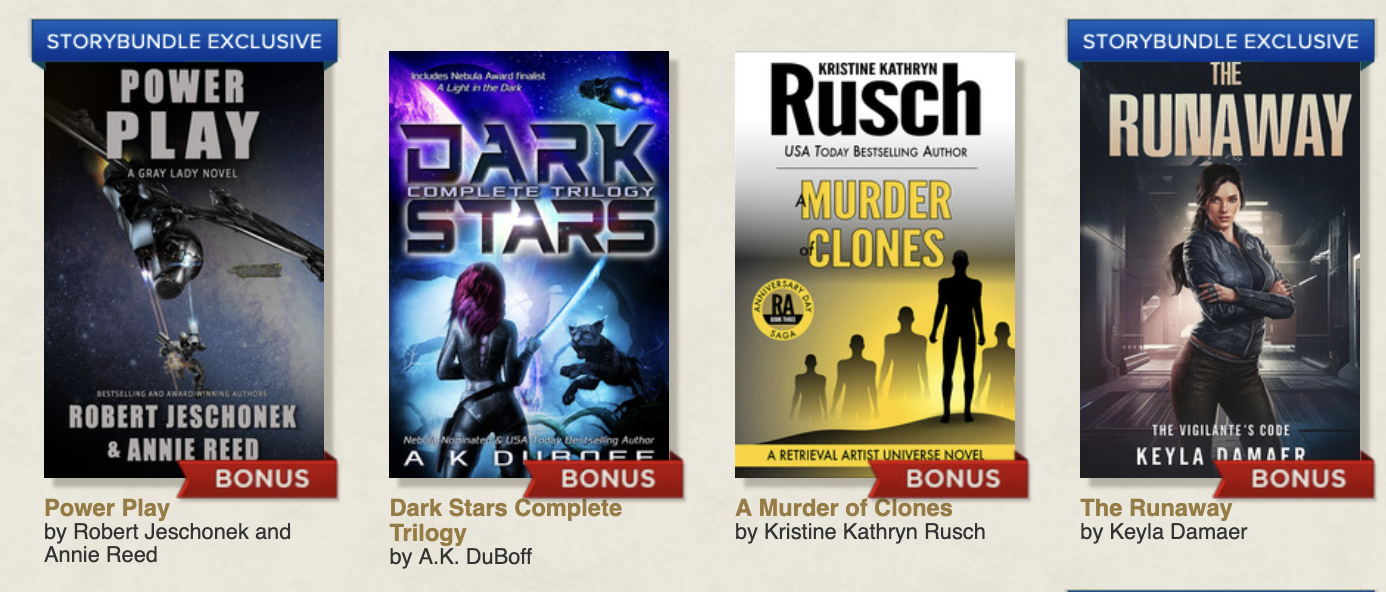
The bundle is curated by Robert Jeschonek: What is it about space opera that makes us love it so much? The action, the exotic settings, the colorful characters, the alien species? The promise of countless adventures in the face of the great unknown? Or is it mostly just the incredible wow factor of all the ships…the technology…the planets…the ray guns and laser swords? In many ways, it’s the ultimate escapist genre, transporting us to places and situations that dwarf our everyday troubles. And yet, at its heart, space opera is all about us—what it means to be human, and how we can triumph over our human limitations. To find out more about the 11 books, including three StoryBundle exclusives and four trilogies, click here, and make sure to click on each cover for a synopsis, reviews and preview of each book!
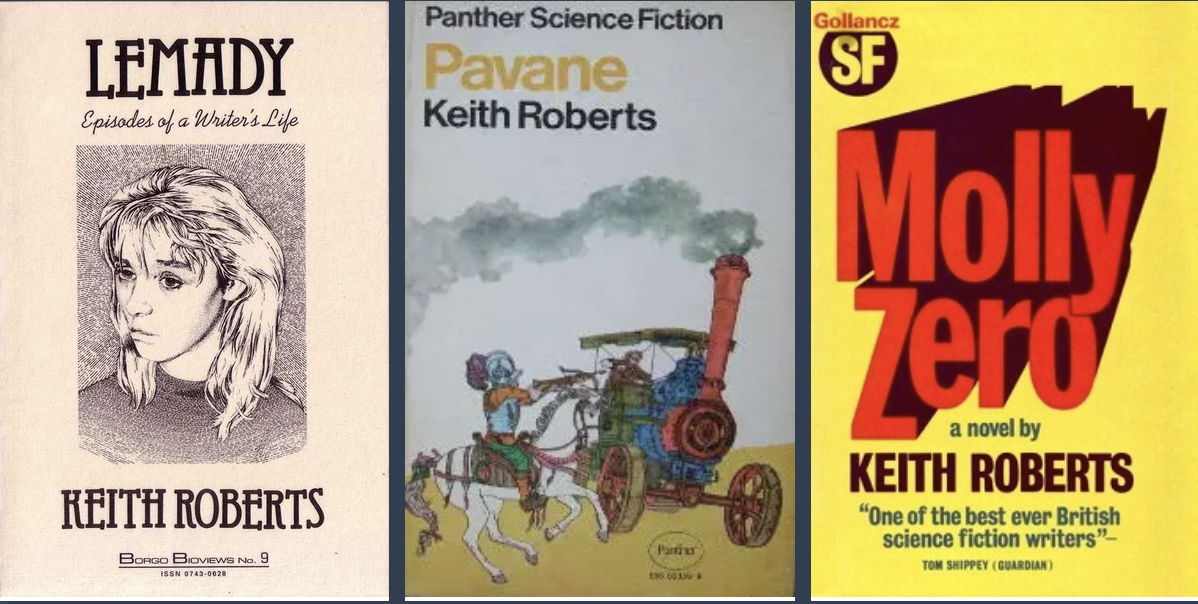
Paul Kincaid, our speaker on Wednesday 3 September, writes “The title of the talk is “Molly and Lemady and Keith”, but that’s really all that’s needed beforehand. I make passing reference to most of his books during the talk, especially Pavane and The Chalk Giants and Molly Zero, but there is no great need for people to rush out and read them first. (I’m rather hoping that people might be tempted to rush out and read them afterwards, but that is a different thing.)”
You know the deal. One of science fiction’s finest critics on one of science fiction’s most interesting writers, directly dialled in to the luxury of your own home or gathered with the fen as we cluster around a large screen in the pristine fashionable white-and-grey expanse of the Conference Room at the Kensington Town Hall, Melbourne.
Meeting details are below, closely followed by a report of last month’s discussion of the best Hugo candidates. The Hugos are announced tonight as I write this.
I’m travelling this month and so the usual second reminder email is unlikely to happen. If you rely on that nearer-the-night reminder, please set your social calendars and reminder alarms now to Paul Kincaid on Keith Roberts.
💥 💥 💥
Molly and Lemady and Keith
Paul Kincaid is our guest for September’s meeting, speaking about Keith Roberts via Zoom from the UK.
“Pavane (stories March-July 1966 Impulse; coll of linked stories 1968; rev with “The White Boat” [December 1966 New Worlds] added 1969) superbly depicts an Alternate History in which – Elizabeth I having been assassinated, the Spanish Armada victorious and no Protestant rise of capitalism in the offing – a technologically backward England survives under the sway of the Catholic Church Militant. The individual stories are moody, eloquent, elegiac and thoroughly convincing. The Inner Wheel (coll of linked stories 1970) deals with the kind of gestalt Superman-cum-Telepathy theme made familiar by Theodore Sturgeon‘s More Than Human (fixup 1953) and is similarly powerful.” — Science Fiction Encyclopedia, text by John Clute.
Please share this invitation with like-minded friends and fans
Face to face
You are invited to a Nova Mob meeting gathered near a big Zoom-related TV screen at the Kensington Town Hall: Wednesday 3 September 2025. 8.00pm – 9.00 (formal close), first floor Presentation Room. Lift access. Stairs access. Both available.
Zoom meeting closes about 9.20pm or so. Kensington Town Hall 30 – 34 Bellair St| Kensington Melbourne VIC 3031
By Zoom – simulcast You are invited to a scheduled Zoom meeting. Please join us on-line!
Wednesday 3 September 2025 8.00pm – 9.30 pm Canberra, Melbourne, Sydney time| 7.30pm – 9.00pm Adelaide time
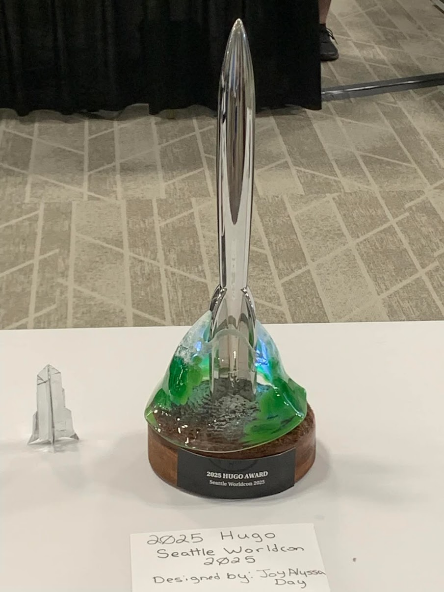
The winners of the Hugo Awards, the Astounding Award for Best New Writer, and the Lodestar Award for Best Young Adult Book were announced on August 16, 2025 by Seattle Worldcon 2025, the 83rd World Science Fiction Convention.
The winners are:
Best Novel: The Tainted Cup, Robert Jackson Bennett (Del Rey; Hodderscape UK) Best Novella: The Tusks of Extinction, Ray Nayler (Tordotcom) Best Novelette: ”The Four Sisters Overlooking the Sea”, Naomi Kritzer (Asimov’s 9-10/24) Best Short Story: “Stitched to Skin Like Family Is”, Nghi Vo (Uncanny 2/24 Best Series: Between Earth and Sky, Rebecca Roanhorse (Saga)
Nikka VanRy published a list of 100 Must-Read SF books by female writers at Bookriot. “From YA to adult lit, from magical realism to epic fantasy to post-apocalyptic sci-fi feminism, from short stories to series, there’s a book on this list for every single reader. Do note that I’ve only listed the first book in any given series, so expect that this list could easily give you ten times as much reading power (especially with those stick-to-your-gut epic fantasy series). I’ve also only included one book per writer to showcase the widest range of voices from sci-fi fantasy novels by female authors”
We invite you to choose one work on that list, or one which you think should be there, and come along to persuade us it is worth reading.
We meet at the Minor Works Building at 6:30pm Wednesday August 20th for the discussion. If you can’t make it in person, you can join us via zoom.
Paul Kincaid, our speaker on Wednesday 3 September, writes “The title of the talk is “Molly and Lemady and Keith”, but that’s really all that’s needed beforehand. I make passing reference to most of his books during the talk, especially Pavane and The Chalk Giants and Molly Zero, but there is no great need for people to rush out and read them first. (I’m rather hoping that people might be tempted to rush out and read them afterwards, but that is a different thing.)”
You know the deal. One of science fiction’s finest critics on one of science fiction’s most interesting writers, directly dialled in to the luxury of your own home or gathered with the fen as we cluster around a large screen in the pristine fashionable white-and-grey expanse of the Conference Room at the Kensington Town Hall, Melbourne.
Meeting details are below, closely followed by a report of last month’s discussion of the best Hugo candidates. The Hugos are announced tonight as I write this.
I’m travelling this month and so the usual second reminder email is unlikely to happen. If you rely on that nearer-the-night reminder, please set your social calendars and reminder alarms now to Paul Kincaid on Keith Roberts.
💥 💥 💥
Molly and Lemady and Keith
Paul Kincaid is our guest for September’s meeting, speaking about Keith Roberts via Zoom from the UK.
“Pavane (stories March-July 1966 Impulse; coll of linked stories 1968; rev with “The White Boat” [December 1966 New Worlds] added 1969) superbly depicts an Alternate History in which – Elizabeth I having been assassinated, the Spanish Armada victorious and no Protestant rise of capitalism in the offing – a technologically backward England survives under the sway of the Catholic Church Militant. The individual stories are moody, eloquent, elegiac and thoroughly convincing. The Inner Wheel (coll of linked stories 1970) deals with the kind of gestalt Superman-cum-Telepathy theme made familiar by Theodore Sturgeon‘s More Than Human (fixup 1953) and is similarly powerful.” — Science Fiction Encyclopedia, text by John Clute.
Please share this invitation with like-minded friends and fans
Face to face
You are invited to a Nova Mob meeting gathered near a big Zoom-related TV screen at the Kensington Town Hall: Wednesday 3 September 2025. 8.00pm – 9.00 (formal close), first floor Presentation Room. Lift access. Stairs access. Both available.
Zoom meeting closes about 9.20pm or so. Kensington Town Hall 30 – 34 Bellair St| Kensington Melbourne VIC 3031
By Zoom – simulcast You are invited to a scheduled Zoom meeting. Please join us on-line!
Wednesday 3 September 2025 8.00pm – 9.30 pm Canberra, Melbourne, Sydney time| 7.30pm – 9.00pm Adelaide time
Table for four under the name of the Nova Mob SF Discussion group also Murray, 6.00pm for 6.15, through to 8.00pm.
A short walk up the hill from the Kensington Railway Station. Not the Newmarket Station!
“At Rick’s Place, we’re more than just an Italian restaurant in Kensington; we’re an experience in the heart of Melbourne. Our culinary skills blend traditional Italian delicacies with innovative Australian flavours, offering a varied menu that appeals to coeliacs, halal-certified meat lovers, low FODMAP, lower carb, vegetarians, and vegans alike. Our dishes are meticulously crafted using only the freshest local ingredients, ensuring that each bite is a burst of unparalleled flavour.”
💥 💥 💥
Hugo Awards discussion at the Mob, August 6 2025 – results
With thanks to Joe Haldeman, marvellous friend to science fiction, for the photo.
The question on the night was “The Hugo Award ceremony is a focal point of Worldcon and a seminal event to celebrate the best SFF works and creators of 2024. It will be held on Saturday, August 16, 2025, in Ballroom 1 of the convention center. Who of the finalists should win?”
Rose Mitchell tackled the novelettes, Lucy Sussex the Short Stories, and Perry Middlemiss the Novellas. Scoring systems varied and a critical consensus arose. The classic thesis, antithesis, synthesis discussion.
Worth your time and ranked with first as best (but will it actually win?)
A Sorceress Comes to Call by T. Kingfisher [SAMPLE]
💥 💥 💥
Great fannish hoaxes
Much tut-tutting back in 2020 when the bulk of the Scots-language wikipedia was found to have been written by someone who knew not of the language. Think of the Muppets’ version of the Swedish Chef, in text form.
“It’s not clear whether the Wikipedian – who identifies as a Christian furry living in the US – has spent the past near-decade creating thousands of fake posts as some kind of incredible practical joke, or that they honestly felt they were doing a good job. There have been occasional interactions with real Scottish folk taking exception to pages, and the administrator has responded in a dead-pan fashion.”
Here’s the lede. Alas no mention of the great fannish tradition of hoaxes. But mentioned here for the sheer scale and hutzpah of the wikipedian’s commitment.
“In an extraordinary and somewhat devastating discovery, it turns out virtually the entire Scots version of Wikipedia, comprising more than 57,000 articles, was written, edited or overseen by a netizen who clearly had nae the slightest idea about the language.
“The user is not only a prolific contributor, they are an administrator of sco.wikipedia.org, having created, modified or guided the vast majority of its pages in more than 200,000 edits. The result is tens of thousands of articles in English with occasional, and often ridiculous, letter changes – such as replacing a “y” with “ee.”
“That’s right, someone doing a bad impression of a Scottish accent and then writing it down phonetically is the chief maintainer of the online encyclopedia’s Scots edition. And although this has been carrying on for the best part of a decade, the world was mostly oblivious to it all – until today, when one Redditor finally had enough of reading terrible Scots and decided to look behind the curtain.
Friends, out-of-town guests, and new arrivals – you are always welcome and have an open invitation to the Mob’s face-to-face and Zoom meetings. First time arrivals – free. Otherwise a $5 donation for expenses please. Donations can be made electronically using playgroups@aussiebb.com.au on Paypal.
Face-to-face meetings are at the Kensington Town Hall:
It’s Hugos time! Nova Mob’s next meeting is a group discussion about the Hugo nominees for the Seattle WorldCon 2025 Awards Ceremony. |We are meeting on Wednesday 6 August at 8.00pm Melbourne time. Who of the finalists should win? Should anyone?
To help you come to a decision here are some freely available nominees. Or ask someone who has received the Hugo pack.
Also in this email, James Cambias has invited us all to a webinar on Space Piracy! Inside me is a 9-year-old boy who is thrilled that I could actually write that phrase in all earnest seriousness!
Sean Williams theAdelaidean has released a new album. The MSFC has held its AGM and it did not drag on, lots of positivity and the new Committee is all set for the move to the new premises. Also some news from the Brisbane WorldCon bid.
Paul Kincaid is our guest for September’s meeting, speaking via Zoom about Keith Roberts of Pavane fame, perhaps the finest alternate history committed to literature.
Sadly and foremost for many is the news of Tess Williams’s passing. Van Ikin enumerates aspects of our loss: “intellectual acumen, her amazing determination and commitment to her work, and her graciousness as a person.”
And a final reddit comment: ““Also nominated for a Hugo (the “Best Related Work” category) and worth reading: Speculative Whiteness which gets into the rise and persistence of the Alt-Right in science fiction.”
💥 💥 💥
Nova Mob meeting 6 August – Hugo Nominees discussion
General all-of-Mob discussion
To help matters along for a couple of the categories, Mob members Rose Mitchell and Perry Middlemiss will provide lead-in comments to start these discussions –
Rose – Novelettes promised to be “not in any great detail nor academic style so no bibliographies nor footnotes, endnotes, or citations, about the Novelettes which I think are the strongest category this year”.
Perry – Novellas commitment is solid – “I’ll have read them all by then”.
Please share this invitation to this forthcoming meeting with like-minded friends and fans
Face to face
You are invited to a Nova Mob meeting gathered near a big Zoom-related TV screen at the Kensington Town Hall: Wednesday 6 August July 2025. 8.00pm – 9.00 (formal close), first floor Presentation Room. Lift access. Stairs access. Both available. Zoom meeting closes about 9.20pm or so. Kensington Town Hall. 30 – 34 Bellair St Kensington Melbourne VIC 3031
By Zoom – simulcast
You are invited to a scheduled Zoom meeting. Please join us on-line! Wednesday 6 August 2025. 8.00pm – 9.30 pm Canberra, Melbourne, Sydney time; 7.30pm – 9.00pm Adelaide time
Also brilliantly put together: Catherynne M. Valente’s Radiance, which is for my money easily one of her most wondrous books. A novel about movies told in part in screenplays, it is also about mysteries, and space whales, and fathers and daughters, secrets, and endings. There are conversation transcripts, gossip columns, switching genres, radio plays—when I think of Radiance I think of narrative abundance. And also of cocktails. It’s glamorous, intimate, and emotional at once, which might be one of Valente’s specialties.
— from “Tell Me a Differently Shaped Story: SFF That Plays With Form” by Molly Templeton, Reactor magazine
Melbourne SF pub meetup. Second Wednesday of every month Next meetup: Wednesday 13 August.
The second Wednesday pub meeting open to all Melbourne fans of SF, fantasy, and horror, announces a change of venue. The time is the same, 6pm every second Wednesday.
Now in Melbourne Central, 6pm. Lion Hotel, Level 3, Melbourne Central, 211 La Trobe St. It’s the big sports bar. Happy Hour is 4pm to 7pm, i.e. 3 hours duration.
The shift is temporary, something to do with AFL and quiz nights.
“Very sad news, which you may have heard by now: Tess Williams died on the morning of Tuesday July 15, in Fiona Stanley Hospital, Perth.
“Tess had just turned 70 and has two sons.
“She was the author of two novels – Map of Power (Random House, 1996) and Sea as Mirror (HarperCollins, 2000) – as well as the anthology Women of Other Worlds: Excursions Through Science Fiction and Feminism, co-edited with Helen Merrick (UWA Press, 1999).
“She suffered from kidney-failure during the 1990s, eventually receiving a transplanted kidney, but in recent years that kidney also began to fail and her life was increasingly hijacked by dialysis and other medical problems.
“Nevertheless, in the last 12-18 months she had made some progress toward writing All the Wild Children, the long-planned third novel in a thematic “trilogy”, and in a burst of renewed creativity she had produced the first few thousand words of an autobiography of herself as a cyborg. I’ve not seen anything of the new novel, but I have seen the earliest work on the autobiography and whilst it was still finding its voice and narrative rhythm, it involved some brilliantly intertextual “side-board” sequences.
“Having supervised her Masters degree and co-supervised her PhD (an as yet unpublished feminist approach to theories of evolution, with reference to several key sf novels), I can attest to Tess’s intellectual acumen, her amazing determination and commitment to her work, and her graciousness as a person. She was a friend and I will miss her greatly.”
Van Ikin, Perth, WA, July 2025.
💥 💥 💥
MSFC AGM results
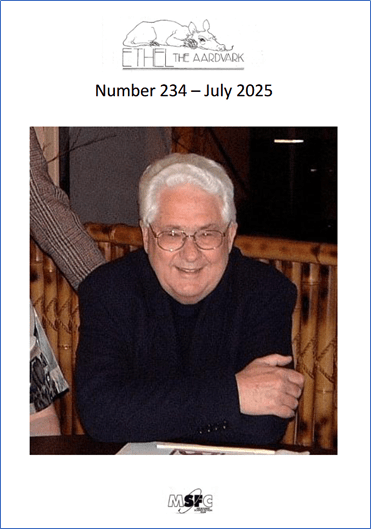
Two Nova Mob members stepped down from their MSFC roles at last Friday 18 July’s AGM of the Melbourne Science Fiction Club. Alison Barton, President for 11 years – her second term in the role – had committed to staying on until the Club and its library found a new home. “It took longer than expected” she reported, revealing again her knack at understatement. LynC also stepped down from newsletter Editor. A tally reveals she is the longest-serving Editor of the club’s zine Ethel the Aardvark. The coming issue will be her last, for a total of 42. Craig Macbride was brief: “I have nothing new to report”. Report accepted.
This is a particularly well edited issue and well worth seeking out even if you are not a MSFC member.
💥 💥 💥
WorldCon Bid – Brisbane 2028
Real Soon Now. And so the bid needs funding. Last week the Australian Science Fiction Foundation arranged for several thousand dollars to go to the bid organisers. [Reported from Carey Handfield].
💥 💥 💥
Speculative Insight #19
Fresh from interviewing Adrian Tchaikovsky at Critical Mass, Alexandra Pierce delivers Speculative Insight 19 which “brings us back to Tansy Rayner Roberts’ essays about the men of Terry Pratchett’s Discworld, and we are finally looking at Sam Vibes – one of my very favourite characters. How do you take a man who’s a functioning drunk (he’s not rich enough to be an alcoholic), who believes in his job but can’t do it properly and has little else to live for – and then turn him into a fascinating, human and humane character whose development is worth following? You need to be Terry Pratchett, I think.
“This essay is free to read: please share it with anyone who might be interested.”
💥 💥 💥
TheAdelaidean – Distant Objects in Soft Focus
“Genres: Ambient Electronic, Atmospheric, Drone, Electronic, LoFi At Bandcamp now & at all streaming and download sites Friday. Name Your Price download for a limited time, includes Free!
“Suspended in slow stasis with frequent pauses for reflection, Distant Objects in Soft Focus is theAdelaidean’s 13th Projekt release of fractalized ambient electronics. Inspired by recent experiences composing for the stage and screen, theAdelaidean (AKA bestselling Australian author Sean Williams) weaves an intricate series of conceptual narratives into an album of densely layered sound. DOiSF imagines the world as a series of half-forgotten moments by means of impressionistic pad washes, looping field recordings, fragmented melodies, and wordless voices. Each complex arrangement leads the listener through forests of lo-fi textures and subconscious resonances of stillness and personal reflection.
“Sean says, “About the ‘Distant Objects’ in my title: my albums are frequently about connecting with things far-off. Whether I’m composing with collaborators who live in different parts of the world, such as Steve Roach and Mirko of Deepspace [Parallels, antigravity], about places like Antarctica [Hyperaurea], or using old field recordings I made when I was young [Isolation], there’s an element held at a remove that I’m trying to engage with. Growing up in Australia, a place so far from the rest of the world, will encourage that. I feel there’s a lot of yearning in my music for something just out of reach.” Track List: 1 Old Water 2 Cryptid Chorus 3 Dawn Fades | Video at YouTube 4 Hide Awake 5 Day Dreamt 6 Melted Memory 7 Gravitic Lens 8 Notion Blur 9 Uncanny Instants 10 Distant Objects in Soft Focus 11 E
The World Fantasy Awards ballot for works published in 2024 has been announced. The awards will be presented during the 2025 World Fantasy Convention, scheduled for October 30 – November 2, 2025 in Brighton, UK.
The Life Achievement Awards, presented annually to individuals who have demonstrated outstanding service to the fantasy field, will go to Juliet Marillier and Michael Whelan.
The World Fantasy Awards finalists are:
Best Novel
The Tainted Cup, Robert Jackson Bennett (Del Rey; Hodderscape)
The Fox Wife, Yangsze Choo (Holt; Quercus UK)
The Bog Wife, Kay Chronister (Counterpoint; Titan UK)
The Bright Sword, Lev Grossman (Viking; Del Rey UK)
The Wings Upon Her Back, Samantha Mills (Tachyon)
Best Novella
Crypt of the Moon Spider, Nathan Ballingrud (Nightfire; Titan UK)
In the Shadow of Their Dying, Michael F. Fletcher & Anna Smith Spark (Grimdark Magazine)
Yoke of Stars, R.B. Lemberg (Tachyon)
The Woods All Black, Lee Mandelo (Tordotcom)
The Butcher of the Forest, Premee Mohamed (Tordotcom; Titan UK)







 The Adelaide Fan Review
You must be logged in to post a comment.